
Investigation teaser
Open video ↗The Ledgers investigation teaser. The video is in English.
The record
SICPA FILES · DERINAY | PART 2
A contract had been signed to transfer the company operating museum ticket offices from Topkapı to Ephesus. While it remained in force, SICPA Türkiye’s management considered four measures potentially affecting that transfer. Its law firm warned that some could breach the agreement. The transfer was not completed by the end of 2022.
The file at a glance
| Date / scope | Development |
|---|---|
| 54 museums and archaeological sites | Including Topkapı Palace, Ephesus, Pamukkale and Göreme. SICPA Türkiye won the nine-year ticketing tender in 2018 with a TRY 3.907 billion bid. |
| 1 March 2022 | Derinay Enerji and SICPA signed the share-transfer agreement for the museum operating company. |
| 14–15 September 2022 | Moving operations, dismissing employees including a signatory, reclaiming vehicles and terminating service contracts were under discussion. Lawyers warned of potential breach and suggested waiting until 1 December to relocate. |
| End of 2022 | The transfer had not been completed. |
| Arbitration | According to Derinay, SICPA was found in breach, but the EUR 120.6 million penalty claim was rejected. |
| Court of Cassation | The dismissal of the annulment action was overturned; the file returned to the Istanbul Regional Court of Appeal. |
A signed contract. Four measures under discussion.
The ticket offices of Topkapı Palace, Ephesus and Pamukkale were set to change hands.
On 1 March 2022, Derinay Enerji signed a share-transfer agreement with SICPA Finance SA and SICPA SA. It envisaged separating SICPA’s Turkish tax-stamp activities and transferring the museum ticketing company to Derinay.
Six months later, SICPA Türkiye’s management had a four-point list before it.
At 12:14 on 15 September 2022, SICPA Türkiye general manager Sami Çebi received an email from the company’s legal adviser, Hergüner. It assessed four issues discussed by telephone the previous evening:
1. Relocating museum operations to another address.
2. Dismissing certain employees, including an authorised signatory assigned under the agreement.
3. Reclaiming vehicles.
4. Terminating service and integration agreements.
All four could affect implementation of the transfer agreement. The law firm considered that some might violate the agreement with Derinay. Its assessment of relocation concluded: “It may therefore be more appropriate to wait until 1 December to put this plan into effect.”
1 December 2022 was a critical point in the agreement’s transition timetable. The advice proposed postponement, rather than abandonment, of the plan.
The transfer was not completed.
A multibillion-lira ticketing business
On 1 March 2018, SICPA Türkiye placed the winning TRY 3.907 billion bid in the ticketing tender run by DÖSİMM, the Ministry of Culture and Tourism’s revolving-fund directorate (Türkiye Turizm). The nine-year contract covered 54 museums and archaeological sites, including Topkapı Palace, Ephesus, Pamukkale and Göreme.
The proposed transfer therefore concerned the entrance gates to some of Türkiye’s most visited heritage sites.
What does the document establish?
The email is not an instruction. A law firm advising its client to wait to avoid breaching a contract is, in itself, ordinary legal advice.
The document does establish that measures capable of affecting the transfer were discussed at management level while the contract was in force. The warning was written: the lawyers told the general manager by email that some measures could conflict with the agreement.
That raises this instalment’s central question: were these ordinary restructuring measures, or part of a plan that would obstruct, delay or effectively undermine the transfer?
Three unanswered questions
The first concerns why the transfer did not complete. The other two concern how the dispute was addressed in legal proceedings.
1. Were the four measures implemented?
The correspondence does not establish implementation. This is the crucial gap.
Did operations move? Was the signatory dismissed? Were vehicles reclaimed and contracts terminated? If so, when and on whose authority? How was the legal warning considered? Did these measures make completion more difficult in practice?
Answers lie in SICPA’s board resolutions, meeting minutes, dismissal records and termination documents. Some may also be in the arbitration file.
2. A breach, but why no EUR 120.6 million?
The failed transfer led to English-language arbitration at the Istanbul Arbitration Centre (ISTAC). According to Derinay’s statement, the tribunal found SICPA in breach of its contractual obligations but rejected Derinay’s EUR 120.6 million contractual-penalty claim, holding that the loss should be assessed as damages (Ekonomim).
The distinction matters. A contractual penalty provides for a sum agreed in advance for breach without a separate requirement to prove loss; damages require evidence of the losses claimed.
The award is not public. It is therefore unknown which conduct was found to breach the agreement or why the penalty was rejected. Nor is it known whether the four September 2022 measures overlap with the conduct considered by the tribunal, or whether this correspondence was submitted as evidence.
3. What should the arbitrator have disclosed?
Derinay sought annulment of the award. Its objection centred on past academic and professional relationships between SICPA-appointed arbitrator Prof. Dr. Erdem Büyüksağiş and SICPA’s lawyers. According to Ekonomim, these included a 2022 construction-law symposium, jointly editing its proceedings with a SICPA lawyer, and an acknowledgement of Büyüksağiş in a book published by a SICPA lawyer in 2025. Derinay alleged that these connections had not been disclosed.
The Istanbul Regional Court of Appeal dismissed the annulment action. The Court of Cassation overturned that decision, finding that the availability of such connections online did not remove the arbitrator’s disclosure duty.
The reversal does not establish bias. It concerns insufficient examination of disclosure obligations. That remains significant in proceedings rejecting a EUR 120.6 million claim.
The file is back before the Istanbul Regional Court of Appeal. If it annuls the award, the dispute could be heard again and the EUR 120.6 million claim reconsidered. The reversal itself is not an award of that sum.
In Switzerland that same week
Another date stands out. An invitation dated 14 September 2022 invited Sami Çebi and another person to meet SICPA chair and CEO Philippe Amon on the evening of 15 September. Further meetings were planned the next day at the company’s Prilly headquarters.
The meeting was scheduled for the evening of the same day the law firm sent its assessment of the four measures.
Which transfer-related decisions fell within local management’s authority in Istanbul, and which were submitted for the Swiss headquarters’ information or approval? Answers lie in the decision-making hierarchy, minutes and email exchanges.
What would establish intent?
The series asks whether the failure to complete the transfer resulted from a deliberate choice. If obstructive measures were taken in the knowledge that they would prevent completion, the issue would be intentional breach rather than an ordinary failure to perform. Such a conclusion requires documentation of three elements:
1. The measures were actually implemented.
2. Decision-makers foresaw that they would obstruct the transfer.
3. Implementation nevertheless continued.
What The Ledgers presents is the plan under discussion and the lawyers’ warning. The remaining evidence lies in decision records, correspondence and the arbitration file.
The question for SICPA is what became of the four measures and who decided.
Background: the CHF 81 million Swiss decision
Separately from this dispute, SICPA faced a corporate criminal liability decision in Switzerland.
On 27 April 2023, the Swiss Office of the Attorney General held SICPA SA criminally liable for failing to take the necessary organisational measures to prevent employees bribing foreign public officials in Brazil, Colombia and Venezuela (OAG; Swissinfo). The prosecutor’s letter to SICPA states that the events concern 2008–2015 and that the decision does not constitute an admission of guilt by the company.
The company was ordered to pay a CHF 1 million fine and an CHF 80 million compensatory claim, totalling CHF 81 million. A former sales manager received a suspended 170-day custodial sentence.
SICPA said it disagreed with the reasoning, that the acts occurred without its consent and against its interests, and that it had sanctioned those responsible and reorganised compliance. It did not appeal.
The prosecutor’s statement does not mention Türkiye. The decision is unrelated to the Derinay dispute.
What comes next
This is the second report in The Ledgers’ SICPA–Derinay series. The first covered the Court of Cassation reversal on 10 October 2026. Subsequent instalments will examine the arbitrator’s links and disclosure obligations, the transfer chronology from September to the end of 2022, who decided each step, and the parties’ arbitration positions and responses.
Readers with relevant information or documents can contact info@theledgers.news. Source confidentiality is protected.
Right of reply and editorial note
The Ledgers welcomes responses from SICPA SA, SICPA Finance SA, Philippe Amon, Sami Çebi, Hergüner, Prof. Dr. Erdem Büyüksağiş and Derinay Enerji. Responses will be published with the same visibility as this report.
This report draws on correspondence obtained by The Ledgers, reporting on court decisions and public sources. Only correspondence necessary to the public interest is reproduced; some names are withheld. The question of intent describes an issue raised by the documents, not a proven finding against anyone. The tribunal’s reasoning on the cause of breach is not public, and no information establishing an official investigation into this matter was found.
The public interest arises from a tender involving ticket offices at landmark heritage sites such as Topkapı Palace and Ephesus. Arbitrator independence also matters to Türkiye’s ambition to be an arbitration centre.
Corrections and replies: info@theledgers.news.
Based on reporting from: Türkiye Turizm; Ekonomim; İsviçre Federal Başsavcılığı; Swissinfo; Federal Savcılık yazısı; SICPA; The Ledgers, 10 Ekim 2026; The Ledgers archive — correspondence dated 14–15 September 2022 and related records; unpublished.
Source documents
08- Türkiye Turizmturkiyeturizm.com
- Ekonomimekonomim.com
- İsviçre Federal Başsavcılığıadmin.ch
- Swissinfoswissinfo.ch
- Federal Savcılık yazısısicpa.com
- SICPAsicpa.com
- The Ledgers, 10 Ekim 2026theledgers.news
- The Ledgers archive — correspondence dated 14–15 September 2022 and related records; unpublishedNo public link supplied
File updates
Report published
Editorial note
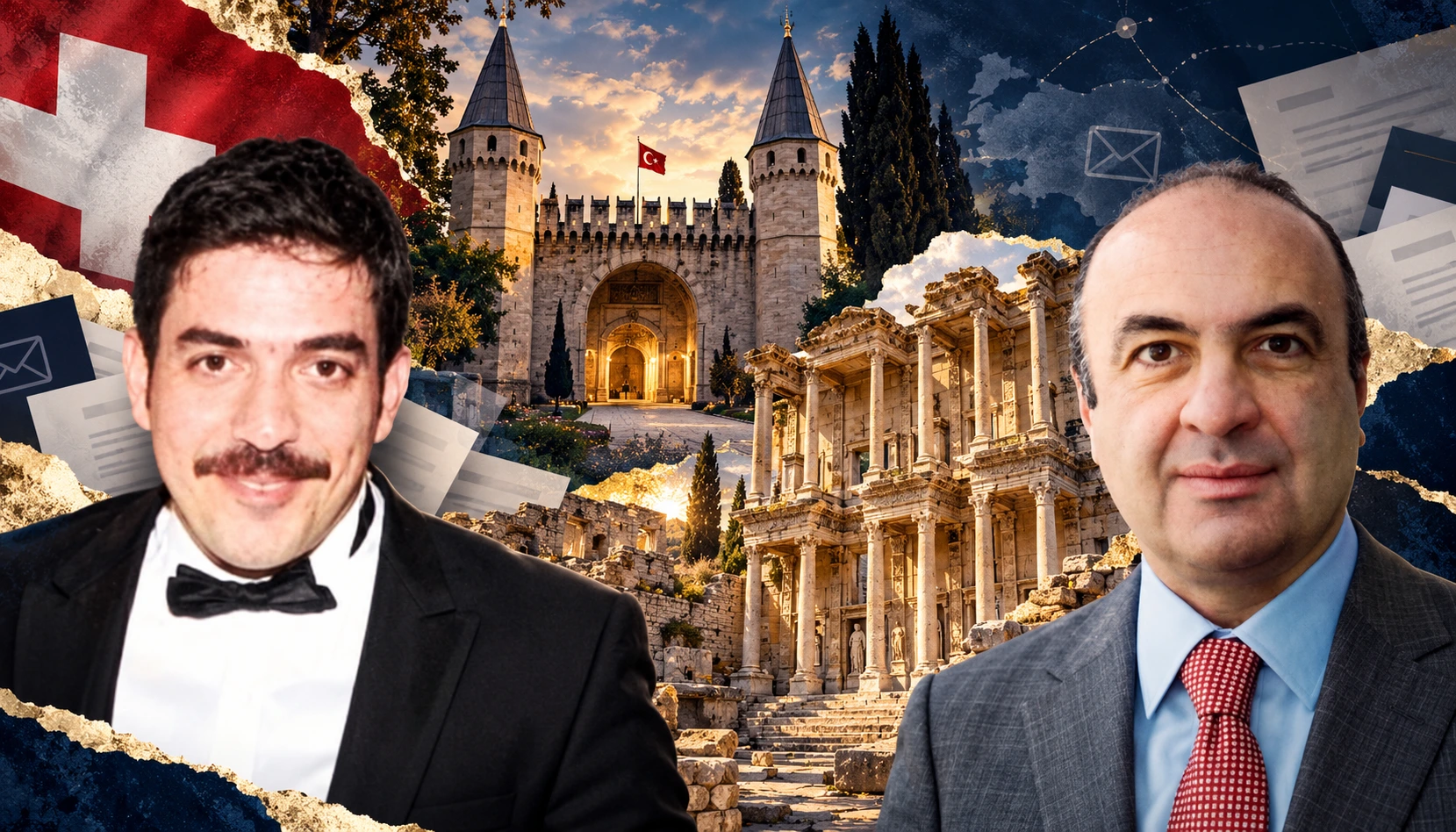
Part two of the SICPA–Derinay series. The correspondence does not establish implementation or deliberate breach; the reversal does not award the EUR 120.6 million claim. The cover is an AI-assisted editorial collage based on supplied portraits, not a photograph of a shared event.
Submit a response or correction ↗︎Reader comments
Verified members can comment. Comments appear after editorial approval. Please address the evidence and avoid personal information.
No published comments yet.
Sign in / Create account →Stay with the story.
Follow The Ledgers for new investigations, developments in our case files and videos.
Choose The Ledgers in Google’s source preferences. Availability is determined by Google.