
Investigation teaser
Open videoThe Ledgers investigation teaser. The video is in English.
The email is three sentences long. The finance director writes that the general manager and Amon approved the payment together on the general manager’s last visit to Lausanne, and that the invoice has only just reached the finance director. Pointing out that the general manager has already approved the payment, the finance director asks Gibert to obtain Amon’s approval on the first page of the attached PDF for audit purposes.
Those three sentences show how a company’s internal procedures were turned upside down. The sequence should have been simple: the invoice arrives, an authorised person approves it, the money goes out. Here the money went out, the invoice arrived five weeks later, and only then did someone ask for a signature “for audit purposes”. And the person whose approval was sought was no ordinary manager. It was Philippe Amon, the owner and chief executive of the SICPA group.
The sum was $350,000. It left the Turkish company’s İş Bankası account in Tuzla and went to Dubai via New York. The invoice came from a consultancy registered in a Sharjah free zone: HCZ Consultancy Services FZE. The description of the work ran to one line: “Consulting Services for the Dubai Water Carboy Project”.
Why would a company that prints excise stamps in Turkey pay a Sharjah firm $350,000 for a water project in Dubai? SICPA’s own documents offer no answer. For that, we must look to a single sentence recounted by a diplomatic source who put the question to Eric Corbier, then a senior executive at SICPA: “Philippe needed a little spending money in Dubai.”
Five documents examined by The Ledgers — the email chain, the İş Bankası transfer receipt, the SWIFT message, the payment instruction and the HCZ invoice — trace the transfer step by step. They reached our editorial team as part of the SICPA file submitted to prosecutors. Their authenticity was cross-checked against one another: the reference number (2430DP706786), amount, IBAN and date match exactly across the documents.
The story begins on the afternoon of Friday, 13 October 2017. At 16:24, the finance director sends an email to Lausanne with the subject “Bank Transfer”. In that one-sentence email, the director asks Gibert to give the general manager a copy of the transfer document. SICPA Turkey’s general manager is in Lausanne with Amon at the time. The transfer document travels from Istanbul to Switzerland, to the owner’s desk.
 Open document at full size
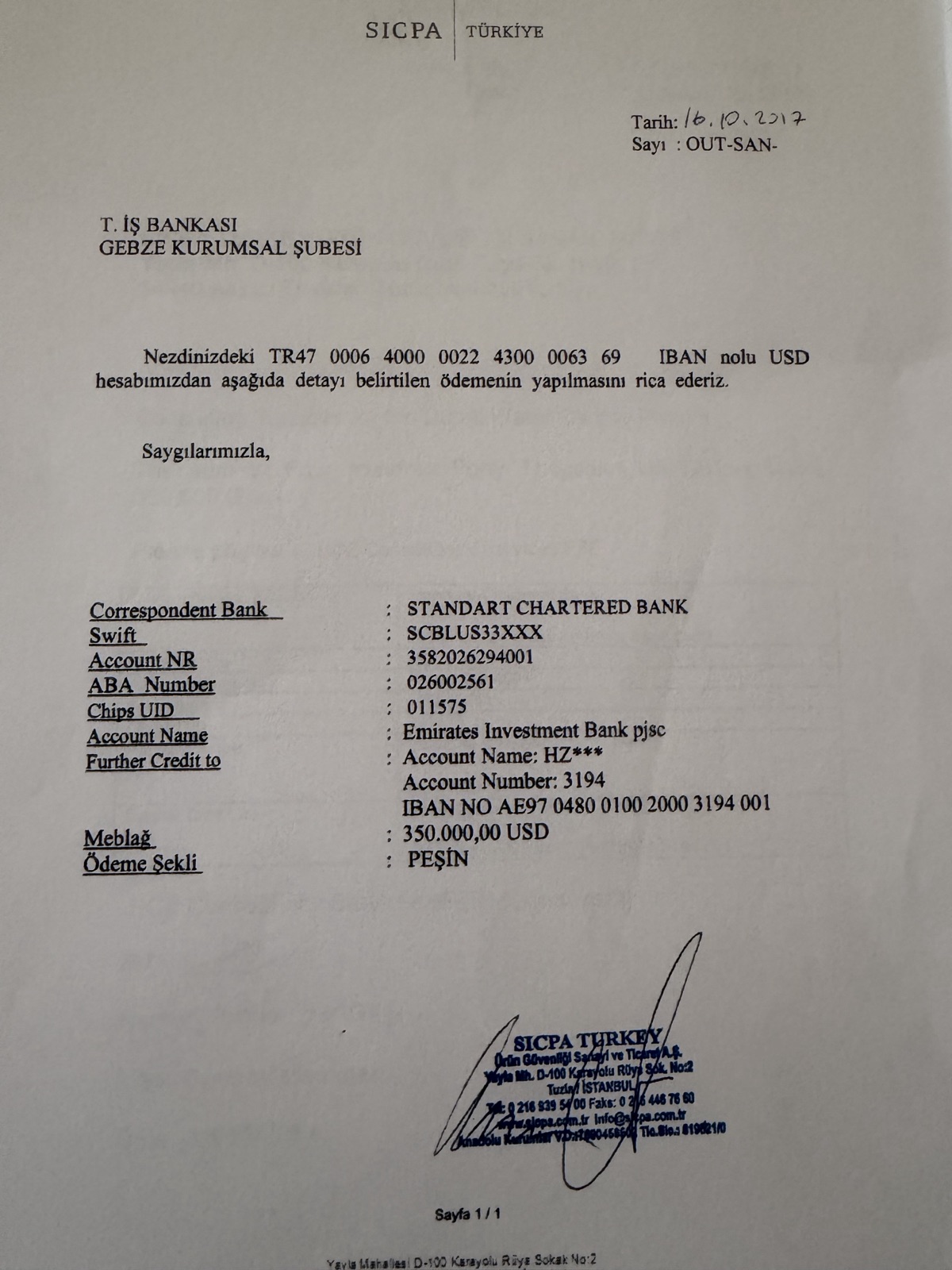
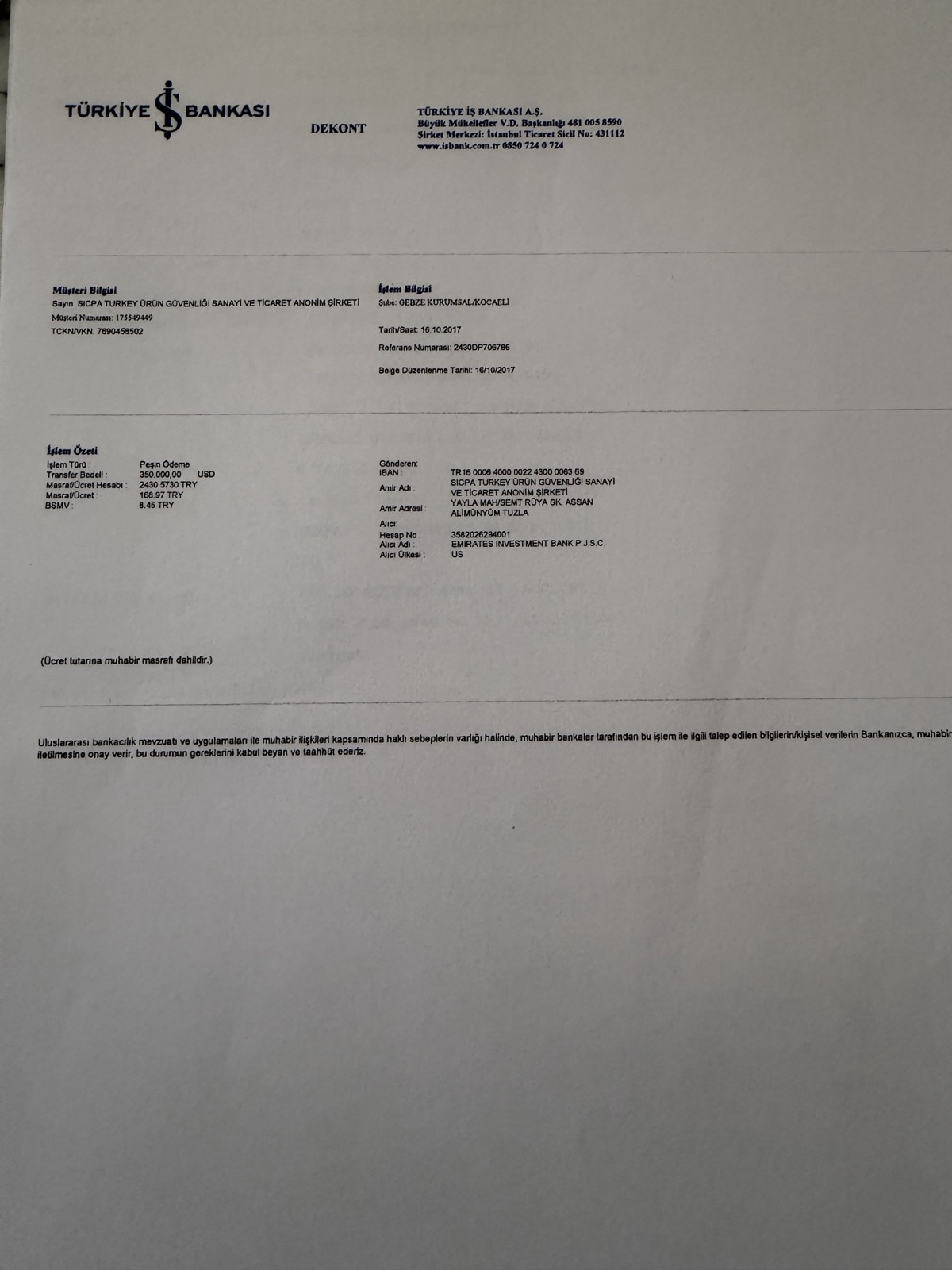
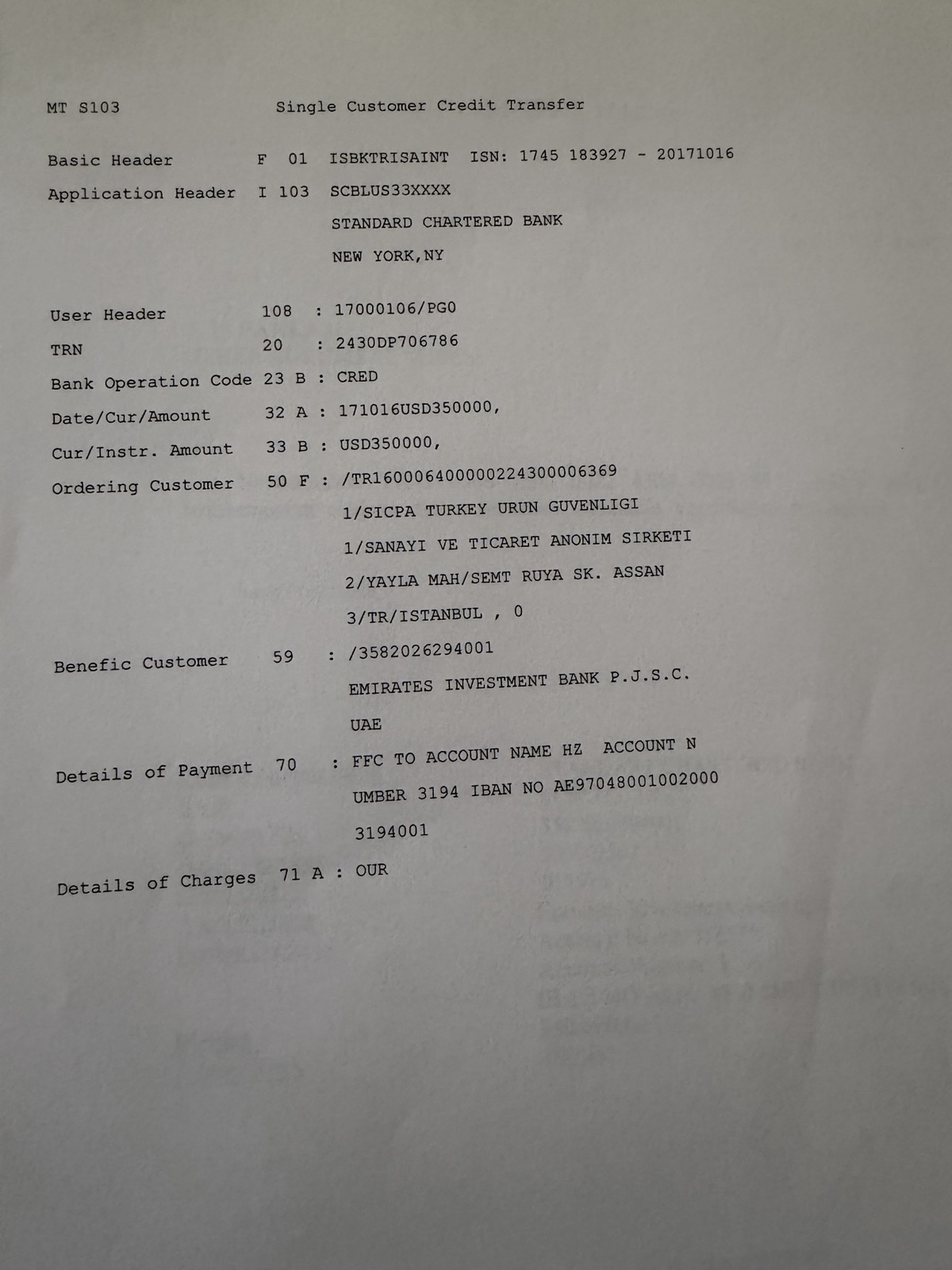
Three days later, on Monday, 16 October, the money goes out. SICPA Turkey Ürün Güvenliği Sanayi ve Ticaret A.Ş. gives İş Bankası’s Gebze Corporate Branch an instruction with a handwritten date and a blank reference number (“OUT-SAN-”): pay $350,000 from its USD account, “in advance”, to Emirates Investment Bank. The bank issues the receipt that day. The fee is 168.97 lira and the banking and insurance transactions tax (BSMV) is 8.45 lira. That same day, a SWIFT MT103 message reaches Standard Chartered Bank in New York. Field 70 names the ultimate beneficiary: “FFC TO ACCOUNT NAME HZ, ACCOUNT NUMBER 3194, IBAN AE97 0480 0100 2000 3194 001”. Charges are marked “OUR”: the sender pays the fees, so the full $350,000 goes to Dubai.
 Open document at full size
There is also an invoice bearing that day’s date: 077/HCZ/10/2017. Yet according to the finance director’s own email, the invoice did not reach Turkey until 24 November. In other words, the bank details on the payment instruction came through another channel, not from the invoice. The invoice was drawn up afterwards and dated to match the payment.
Forty-two days later, on 24 November, the finance director is looking for Amon’s signature. The reason, in the director’s own words: “for audit purposes”. There is only one reason for a finance director to write that sentence: a signature the auditor will ask for is missing from the file.
| Date | Document | What it says |
|---|---|---|
| 13.10.2017, 16:24 | Email, SICPA Turkey finance director → Gibert (Lausanne) | The finance director asks for a copy of the transfer document to be given to the general manager |
| 16.10.2017 | Payment instruction, SICPA Turkey → İş Bankası Gebze | USD 350,000, in advance. “Further credit to: HZ***, account 3194” |
| 16.10.2017 | İş Bankası receipt, ref. 2430DP706786 | Beneficiary: Emirates Investment Bank P.J.S.C. The receipt lists the beneficiary country as “US” |
| 16.10.2017 | SWIFT MT103 | Via Standard Chartered New York. FFC “HZ”, IBAN AE97…; charges OUR |
| 16.10.2017 | Invoice 077/HCZ/10/2017, HCZ Consultancy Services FZE, Sharjah | Consultancy for the “Dubai Water Carboy Project”. $440,000 in words, $350,000 in figures |
| 24.11.2017, 09:26 | Email, finance director → Gibert, cc Gard and Cousteau | The finance director writes that Amon and the general manager approved the payment in Lausanne and that the invoice has only just arrived. The director asks for Amon’s signature for the audit |
 Open document at full size
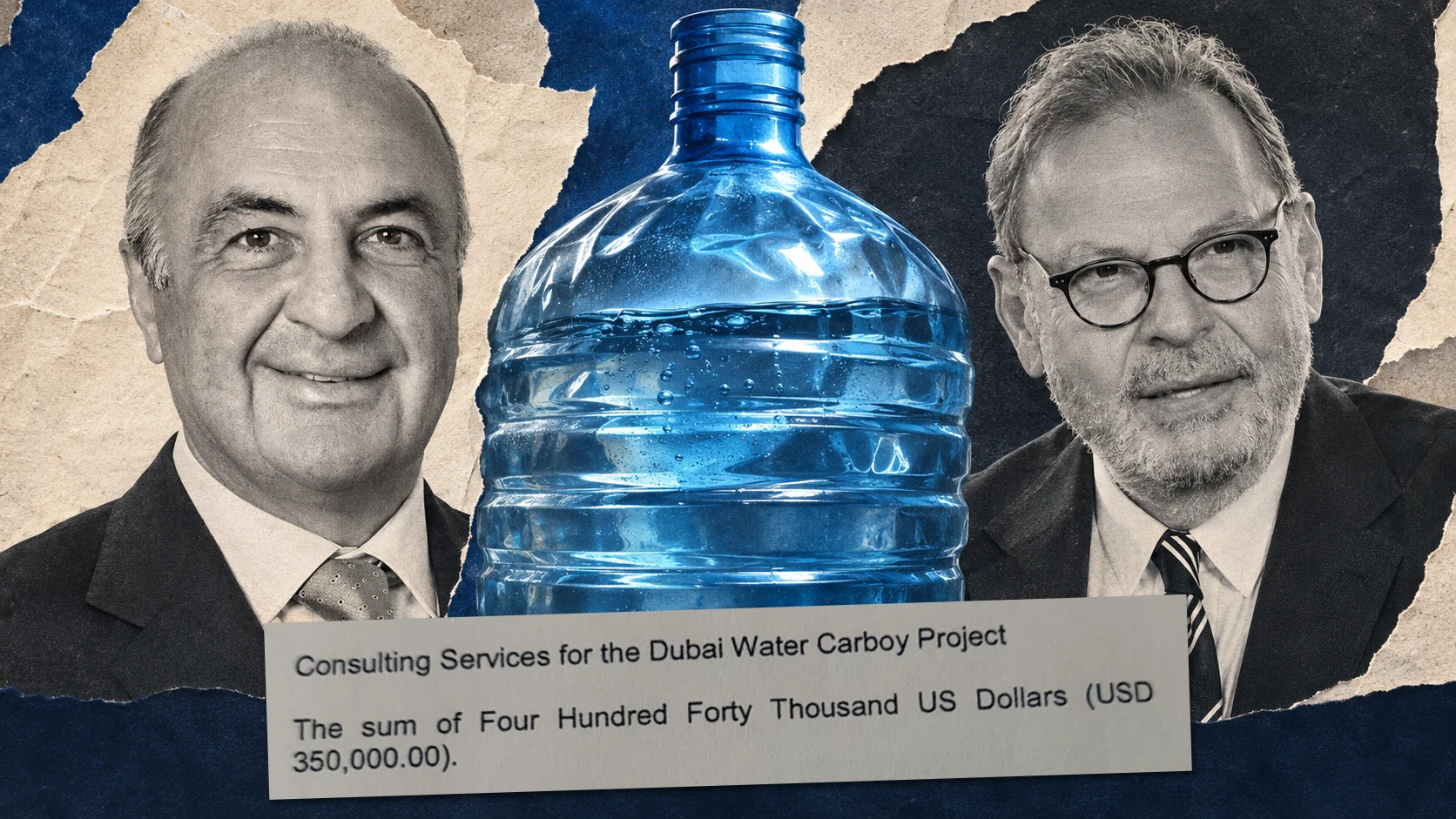
The invoice header reads HCZ Consultancy Services (FZE), P.O. Box 123873, Sharjah. It is addressed to SICPA Turkey, Tuzla. The work is described in a single line: “Consulting Services for the Dubai Water Carboy Project”. No contract number, no period of service, no report delivered, no hours, no names. Not one word about what the consulting work involved.
Then comes the amount, and the document contradicts itself: “The sum of Four Hundred Forty Thousand US Dollars (USD 350,000.00)”. Four hundred and forty thousand in words, three hundred and fifty thousand in figures. No accounting department in the world would accept that invoice without asking for a correction. SICPA Turkey did. Indeed, it paid the amount in figures before it even had the invoice. What accounts for the $90,000 difference, and whether the invoice was drawn up for another sum and later altered, remain open questions.
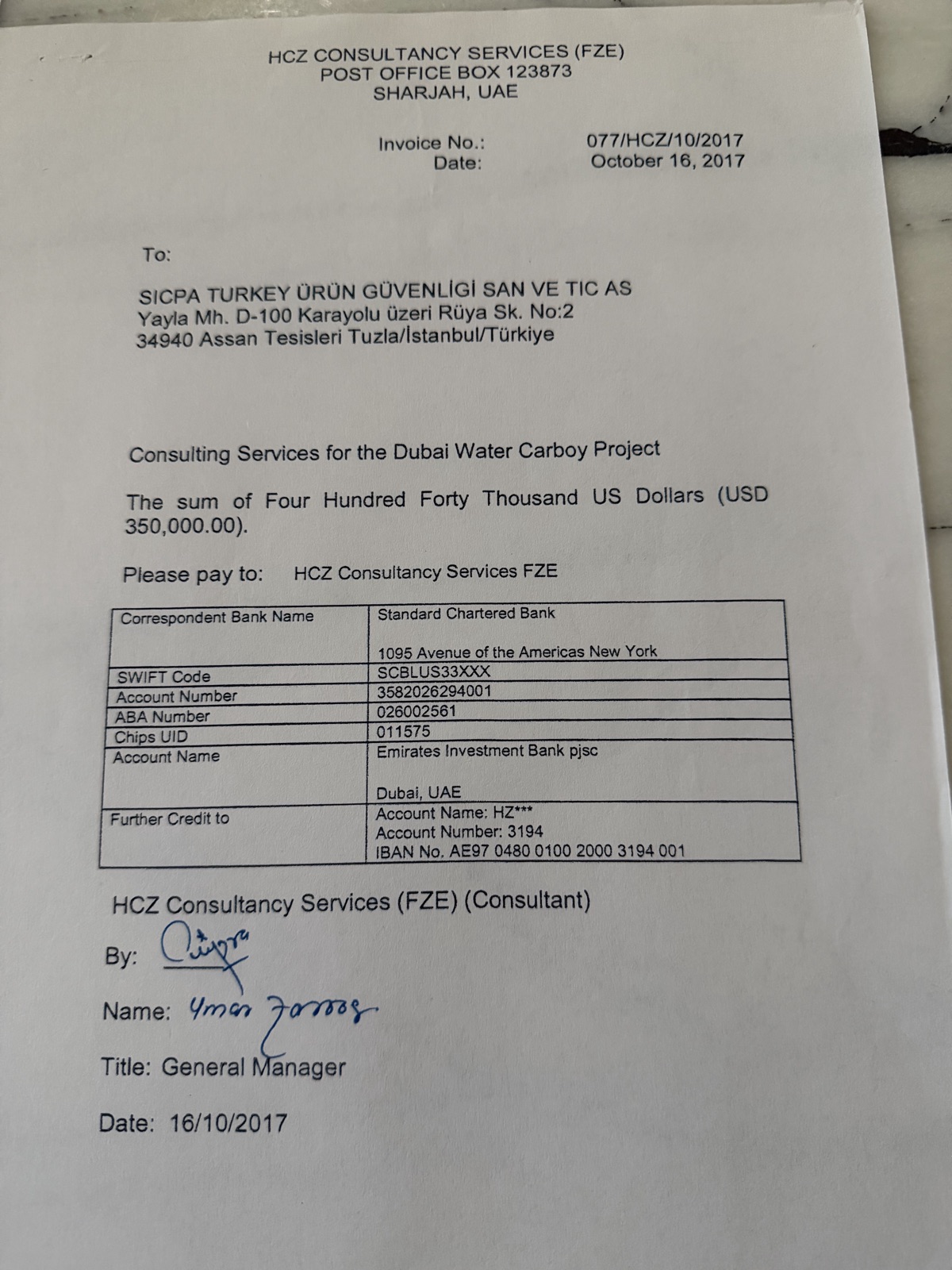 Open document at full size
The invoice number also tells us something: 077. If the numbering is sequential, this document, issued in October 2017, was HCZ’s seventy-seventh invoice. For an “FZE”, a single-shareholder free zone establishment in Sharjah, that represents a considerable volume of business. For whom, and for what?
At the bottom are a handwritten name and a signature in the capacity of general manager. The name appears in another document in SICPA’s Lausanne records. We will come to it shortly.
The banking details, by contrast, are remarkably precise. The correspondent bank is Standard Chartered New York, with its ABA and CHIPS numbers. The account holder is Emirates Investment Bank pjsc, Dubai. The ultimate beneficiary is “Account Name: HZ***”, account 3194. The decision to mask the account name with asterisks was the invoice issuer’s. The SWIFT message has no such mask: “HZ”.
Emirates Investment Bank is a small Dubai institution that offers private banking services to wealthy individuals. The fact that the $350,000 was credited to a private banking client’s account rather than a consultancy’s business account raises a question about more than where the money ended up. For whom was it held there?
The name HCZ Consultancy Services FZE appears in another SICPA document previously examined by The Ledgers: a “Deed of Assignment” dated 8 July 2016, effective from 28 June 2016. The parties were SICPA SA, Cüneyd Zapsu Danışmanlık A.Ş. and HCZ Consultancy Services FZE. The HCZ seal on the document gives a post office box: 123873, Sharjah. It is the same box as on the invoice.
The deed transferred to HCZ, “for strategic reasons”, all four consultancy agreements that Zapsu’s company had signed with SICPA from 2012 onwards, covering the traceability of tobacco, alcohol and agricultural products in Turkey. Philippe Amon and the group’s general counsel signed for SICPA. H. Cüneyd Zapsu signed on Zapsu’s side. The three letters in HCZ match the initials of Hasan Cüneyd Zapsu. Set that alongside the account name “HZ” in the SWIFT message and the identical post office box, and a picture emerges: the $350,000 that left SICPA Turkey in the autumn of 2017 went to the Sharjah company to which Cüneyd Zapsu’s relationship with SICPA had been transferred.
Here the documents leave a question unresolved. Zapsu’s consultancy contract was with SICPA SA, the parent company in Lausanne, rather than with SICPA Turkey. The same information appears in a 2019 WhatsApp exchange we published earlier. According to the message sent to Amon from SICPA Turkey, the manager in Turkey had not signed the contract. The message says Amon and Eric signed it and that Zapsu remained a consultant to SICPA SA.
The contract was in Lausanne, the signatures in Lausanne, the approval in Lausanne. The money, however, came from Tuzla. And the work on the invoice concerned neither Lausanne nor Tuzla. It concerned a water project in Dubai.
In those same months, another payment channel was open. According to payment records previously published by The Ledgers, from August 2017 SICPA Turkey paid Zapsu’s Turkish company a quarterly “consultancy fee” of $120,000 plus 18 per cent VAT. In other words, the same company was paying the same consultant through two channels. One was in Turkey, invoiced, with VAT, in full view of the tax office. The other was in Sharjah, without VAT, described as a “water carboy” payment, with the owner’s signature sought after the fact.
The “Dubai Water Carboy Project” was real. According to SICPA’s own website, on 22 August 2016 the company signed a food safety traceability agreement with Dubai Municipality. The first products covered were “water carboys and halal products”. The signing ceremony took place at the municipality’s headquarters, where Philippe Amon himself signed for SICPA (SICPA). Gulf News described the project as a “joint venture” between the municipality’s food safety department and “Swiss company SICPA”: a smart label for every water jug, and a maximum of 33 refills (Gulf News). In early 2017, SICPA executive Hany Hashem said the system would go live “within a few weeks” and cover all water plants by July (Salaam Gateway/Zawya).
So by October 2017, when the invoice was issued, Dubai’s water jug system was already operating. It was SICPA’s project, Dubai Municipality was the client, and Amon had signed the contract. SICPA’s Turkish company had no role in this project. Why would a company that operates excise stamp and museum ticketing systems in Turkey pay for “consultancy” on a municipal project in the Gulf?
The dates suggest something else. On 28 June 2016, Zapsu’s SICPA contracts were transferred to HCZ in Sharjah “for strategic reasons”. SICPA signed its contract with Dubai Municipality eight weeks later. That Zapsu needed a consultancy in the Gulf, in the United Arab Emirates, in precisely the summer SICPA entered Dubai may be a coincidence. But coincidence does not explain why the invoice that company issued a year later named the Dubai project and why the payment came from Turkey.
If HCZ really did provide consulting services on the Dubai project, the invoice should have gone to Lausanne or to SICPA’s operation in Dubai. If it did not, the invoice exists to justify a payment rather than an actual service. Neither possibility explains why the expense is on SICPA Turkey’s books.
One person knew this transfer from inside SICPA: Eric Corbier. The French executive joined SICPA SA as vice-president for business development in April 2015 and became the group’s chief commercial officer in February 2017 (Atlantic Council). Corbier is the Eric whom the 2019 WhatsApp message identifies as having signed the contract with Amon.
A Turkish ambassador who spoke to The Ledgers on condition of anonymity says they personally asked Corbier about this payment. The ambassador recounts the answer in one sentence: “Philippe needed a little spending money in Dubai.”
If accurate, that sentence would mean the $350,000 transfer was money taken out of the Turkish company for the group owner’s personal needs, rather than a consultancy fee. It would give a single explanation for all the oddities in the documents: payment first and invoice later, one amount in words and another in figures, a description that says nothing about the service, and a signature sought after the fact for an audit.
This is a witness’s account, not a document. We asked Corbier whether he said this and, if so, what he meant. We will publish his response with equal prominence when it arrives. The documents do establish this much: Amon gave verbal approval for the payment in Lausanne, his signature was sought later, and the money went, in the name of the Dubai project he personally signed in 2016, to the Sharjah company established by the deed of assignment he also personally signed in 2016. The same signature on all three documents: Philippe Amon.
The fact that the money came from Turkey turns an internal corporate anomaly into a question of tax owed to the Republic of Turkey. SICPA Turkey is a joint-stock company liable for Turkish tax. It earns nearly all its income from Turkish public institutions through excise stamps and museum ticketing. Every expense entered in its books reduces the corporate tax payable in Turkey.
A “consultancy” payment to a Sharjah company for a municipal project in Dubai is an expense for which no connection to the Turkish operation can be established. Turkey’s Corporate Tax Law addresses this explicitly. Expenditure unrelated to earning business income cannot be deducted. A payment to a related party at a price that departs from the arm’s-length rate is deemed a “disguised distribution of profits” and taxed as a dividend. If consultancy services purchased abroad are used in Turkey, the company receiving them must declare 18 per cent VAT under the reverse charge. If the services are not used in Turkey, it follows that the expense does not belong to the Turkish company. One of two things necessarily follows: either VAT and withholding tax were underpaid, or the expense was wrongly claimed.
The questions are specific. Did SICPA Turkey deduct the $350,000 in its 2017 corporate tax return? Did it declare reverse-charge VAT? Did it withhold tax on the professional fee paid to a non-resident company? If it did not, is there a tax residence certificate on file showing that it relied on the Turkey–UAE double taxation agreement? Given the difference between 440,000 and 350,000 on the invoice, which amount was entered in the books? The answers are in the returns held by the Turkish Revenue Administration. We have asked and await its reply.
This is not the only document we have concerning SICPA’s shifting of tax from Turkey to another jurisdiction. In correspondence previously examined by The Ledgers, another intermediary that advised SICPA in Turkey, Georgia-based Avialift LLC, wrote that invoicing through the Turkish company had been considered. When “18 per cent VAT is too high” was raised, the parties agreed to invoice through the US company at 7 per cent: “this saved you 11 per cent.” The method is the same: the service in Turkey, the invoice abroad, the tax nowhere. The difference in the HCZ case is that the money left the Turkish company’s coffers with the group owner’s own signature.
The question for Zapsu is just as serious. Why did a consultant whose contract was with SICPA SA, and who billed separately through his Turkish company with VAT, receive money from Turkey through his Sharjah company in the name of the Dubai project? Was HCZ’s invoice based on an actual service, or did Zapsu’s company issue it so that somebody else’s money could leave Turkey? The second possibility would mean a businessman allowing his own company to be used for another person’s tax evasion. Turkey’s Penal Code and Tax Procedure Law give that conduct a name. We put these questions to Zapsu.
The remark about “spending money in Dubai” carries weight because Amon’s connection to Dubai extends beyond a signing ceremony. Company and beneficial ownership records obtained by The Ledgers show that Philippe Amon has economic and commercial ties to the United Arab Emirates through several companies. The chain runs as follows: Amon owns 100 per cent of Argaman Holding. Argaman Holding owns 70 per cent of SICPA Holding. Beneath SICPA Holding are subsidiaries registered in the UAE. The records identify Amon by name, trace the corporate chain and give his economic interest.
In other words, although SICPA had companies of its own in Dubai, the “consultancy” fee for the Dubai project was paid by its Turkish company. The owner of the group was in a position to choose which pocket the money would come out of. He chose Turkey. The money in the Turkish company’s hands came from excise stamp and ticketing revenue collected from Turkish public institutions.
Our documents show no direct ownership link between Amon’s corporate network in the Gulf and HCZ in Sharjah, and we make no such claim. What we do assert is what the documents show: the same person approved the payment, signed for the Dubai project, signed the deed of assignment that established the recipient company, and owned companies registered in his name in Dubai. At every link in that chain, it was the same person whose signature a finance director was seeking “for audit purposes”.
File updates
Report published
Reader comments
Verified members can comment. Comments appear after editorial approval. Please address the evidence and avoid personal information.
No published comments yet.
Sign in / Create account →Stay with the story.
Follow The Ledgers for new investigations, developments in our case files and videos.
Choose The Ledgers in Google’s source preferences. Availability is determined by Google.