Investigation teaser
Open videoThe Ledgers investigation teaser. The video is in English.
The record
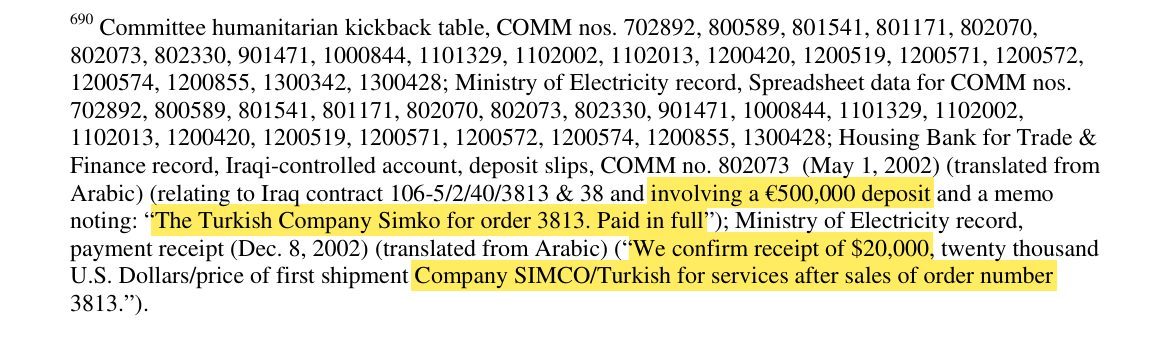
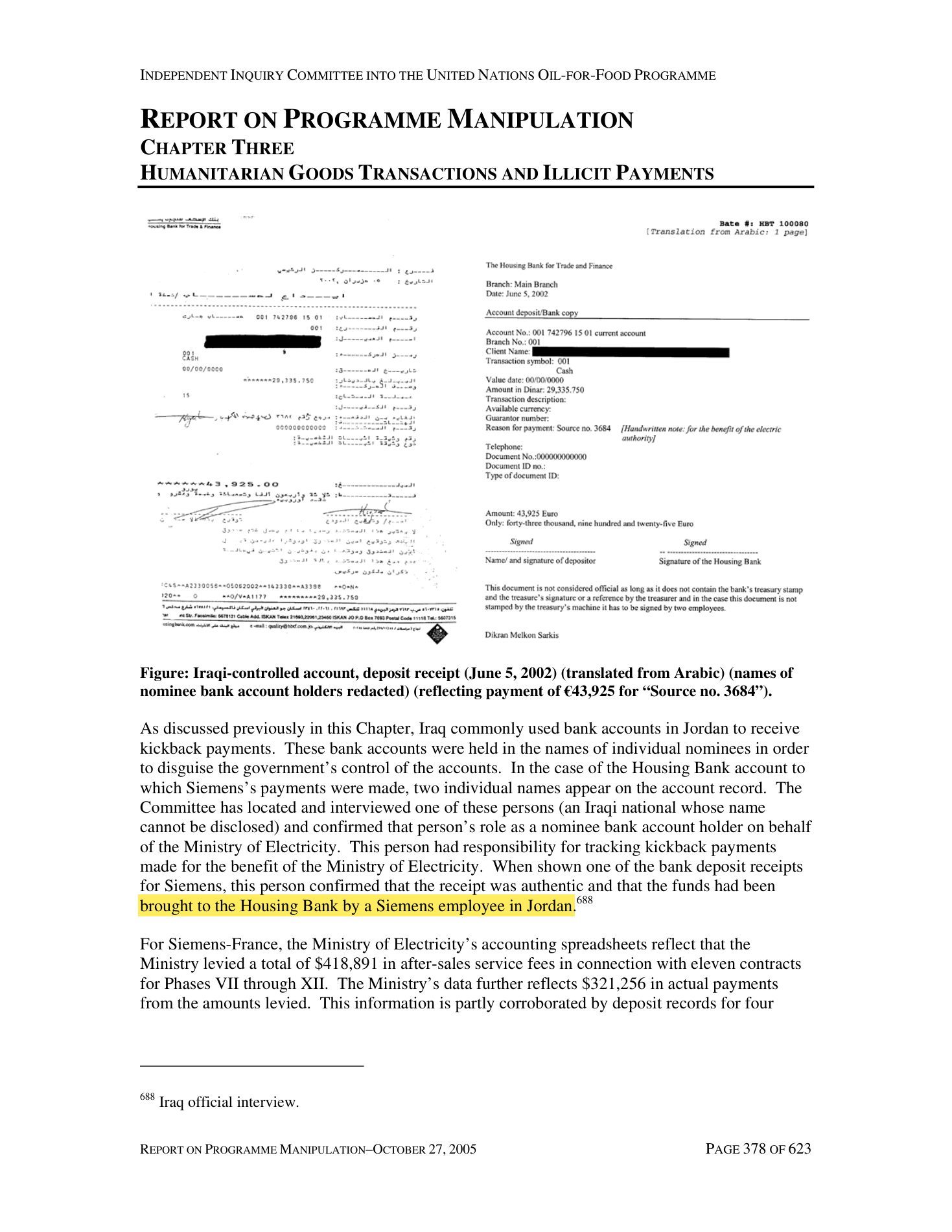
A deposit slip in Amman
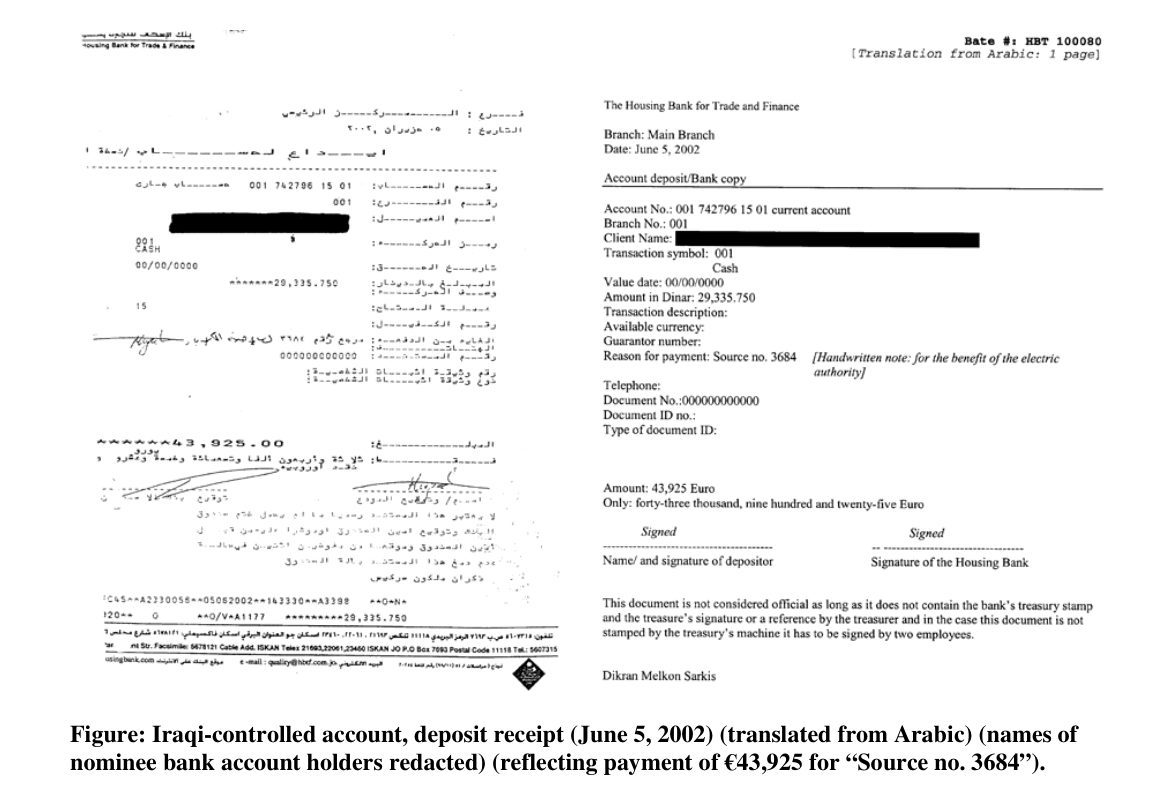
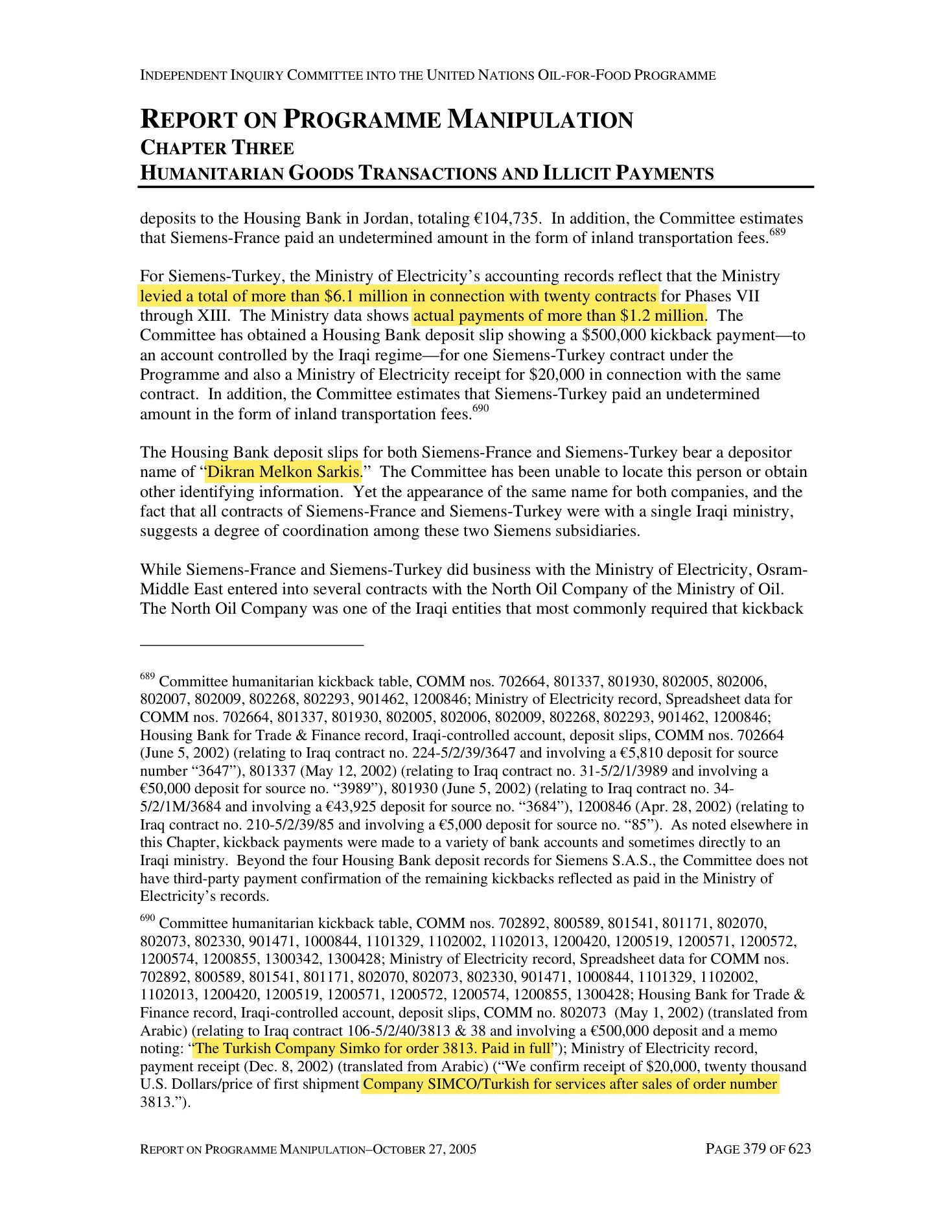
In May 2002, a cash deposit of 500,000 was made into an account at the Housing Bank for Trade & Finance in Amman, Jordan. The account appeared under two Iraqis’ names but was in fact controlled by Iraq’s Ministry of Electricity. An Arabic notation identified the Turkish company Simko, order 3813, and stated that payment was complete.
Seven months later, on 8 December 2002, the ministry issued its own receipt: US$20,000 received from “SIMCO/Turkish company” as an after-sales service payment for the first shipment under order 3813. There was no corresponding service. In Baghdad, the description concealed a payment of 10% of the contract price to Saddam Hussein’s government. [2]
 Open document at full size
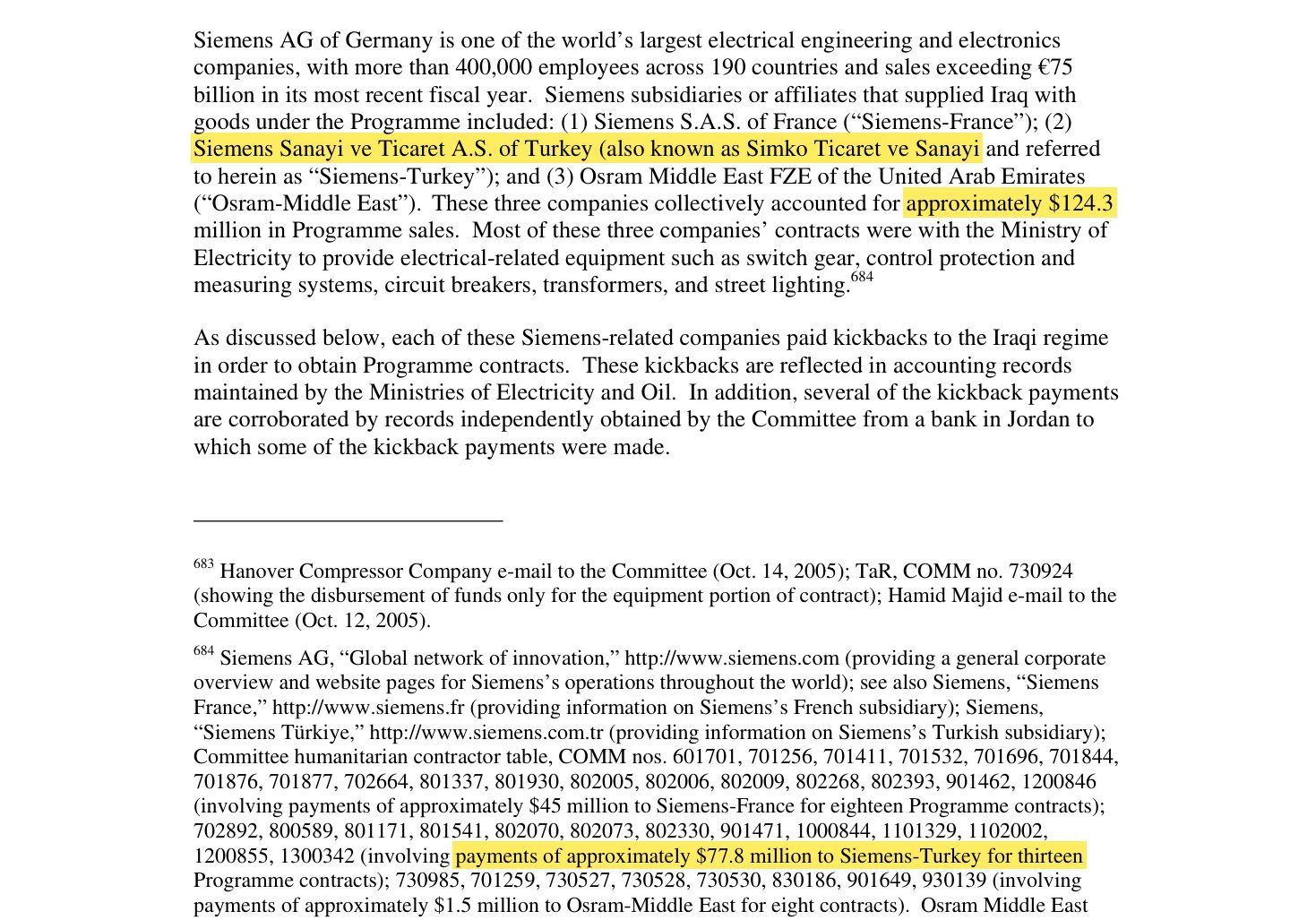
The document images in this report come from public official records. Their wording is unchanged. Yellow highlighting was added by The Ledgers solely to identify the relevant passages. Full-page images appear in the document appendix below.
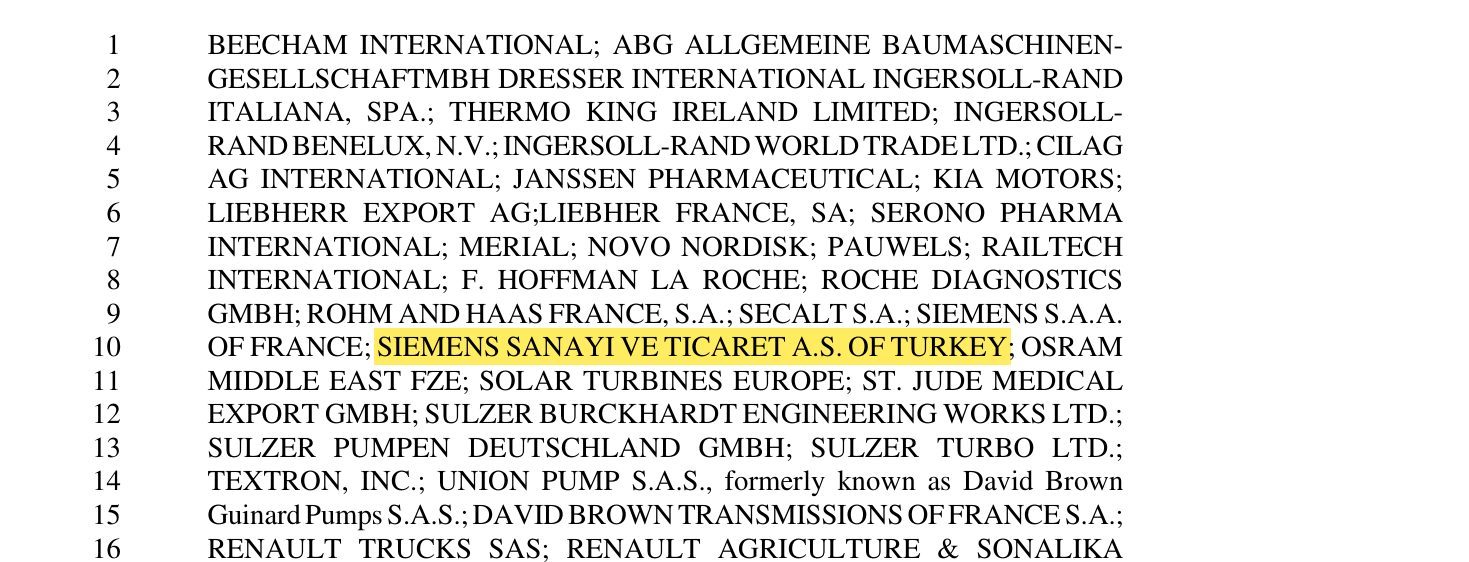
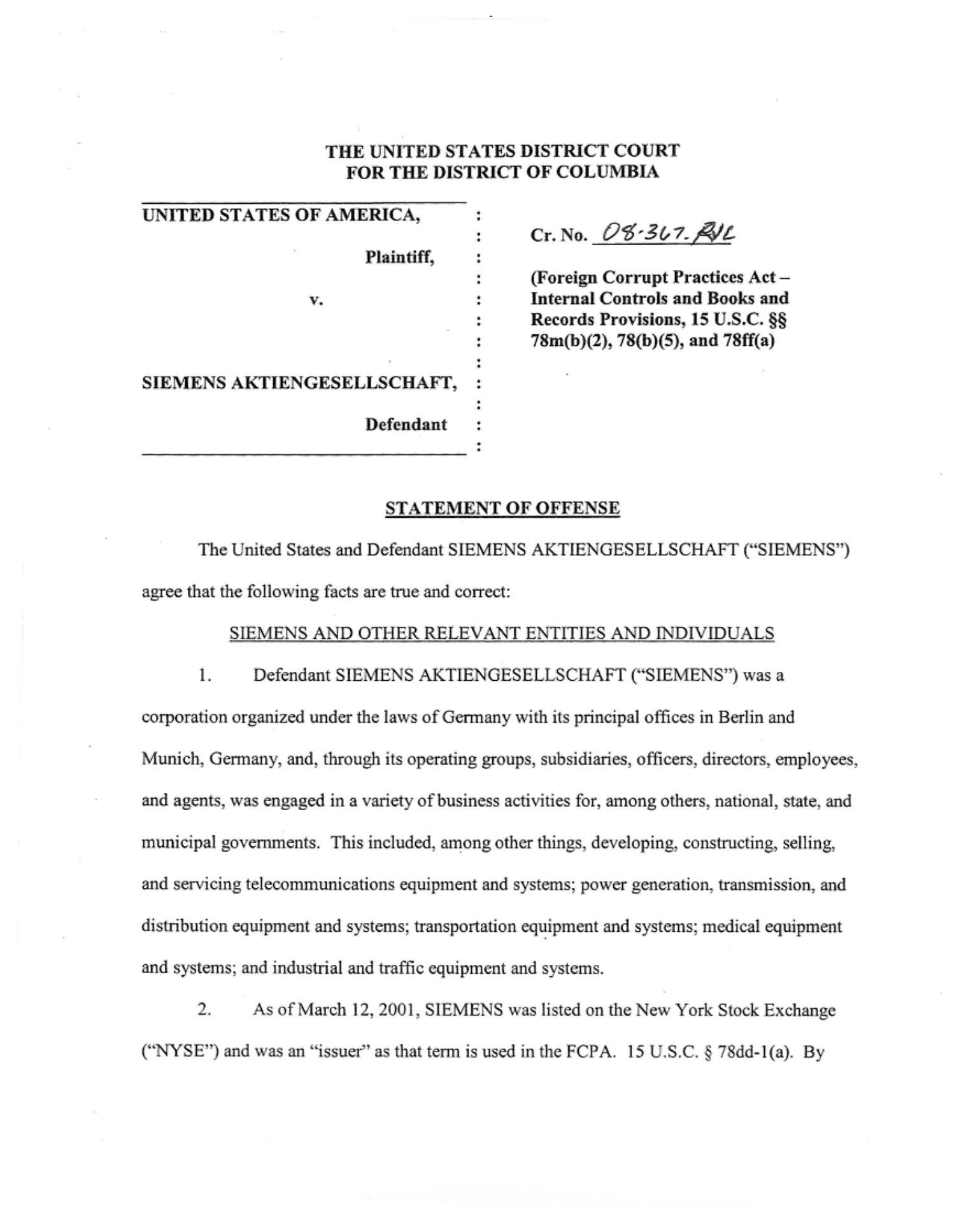
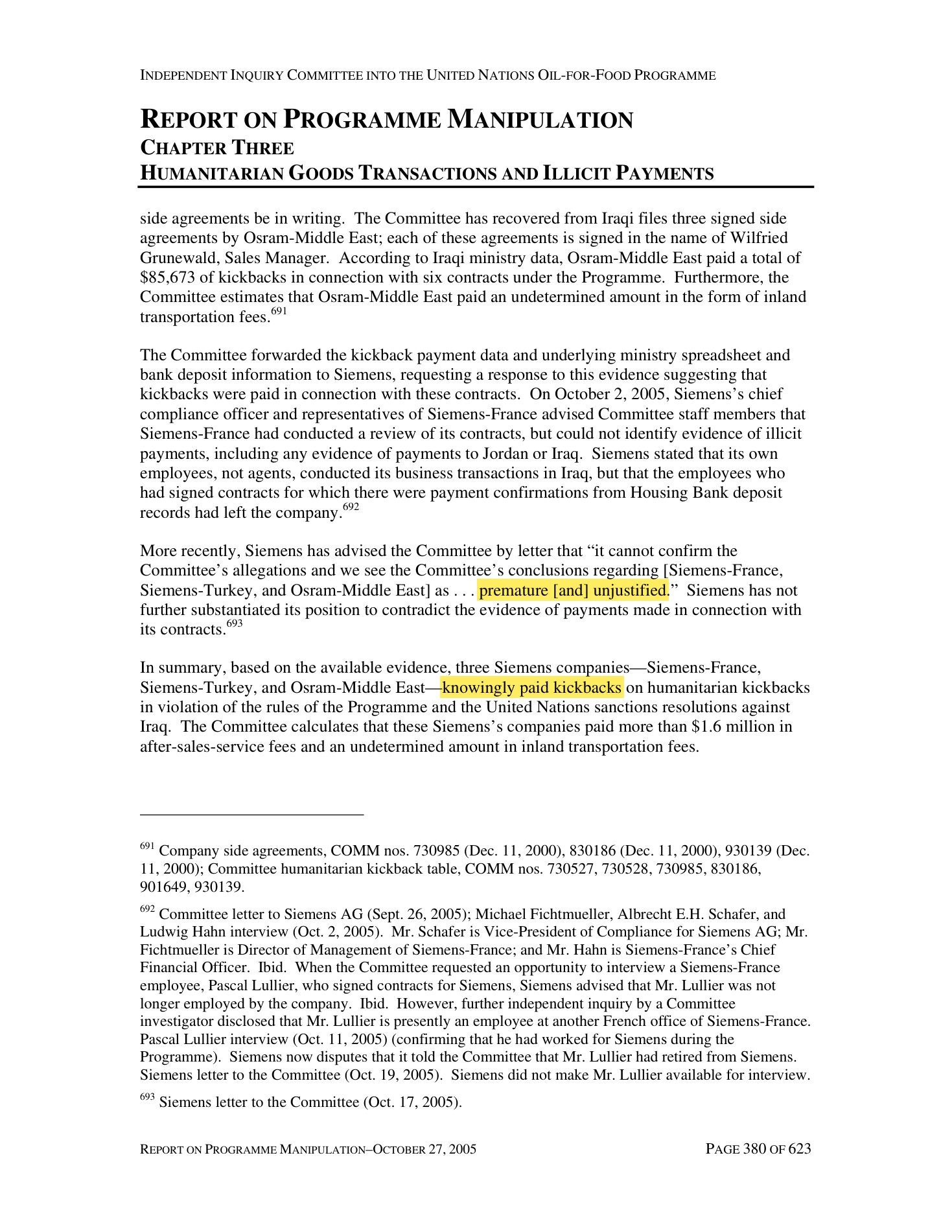
The UN report identified Simko as another name for Siemens Sanayi ve Ticaret A.Ş. Both records appeared in the 2005 report of the Independent Inquiry Committee chaired by Paul Volcker. Siemens then described the committee’s conclusions as premature and unjustified. Three years later, in its statement of offense submitted to a federal court in Washington on 15 December 2008, Siemens AG accepted the underlying payments as facts. [1][2]
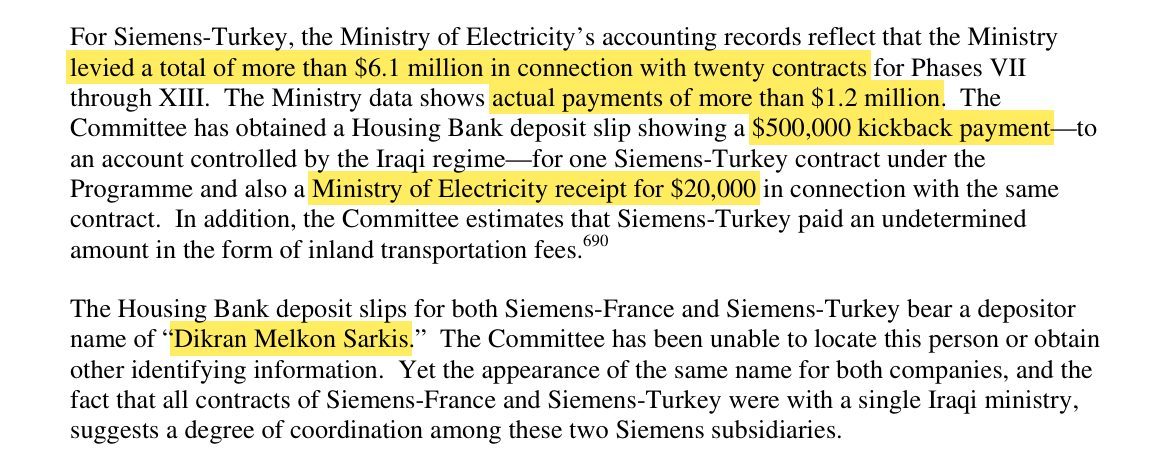
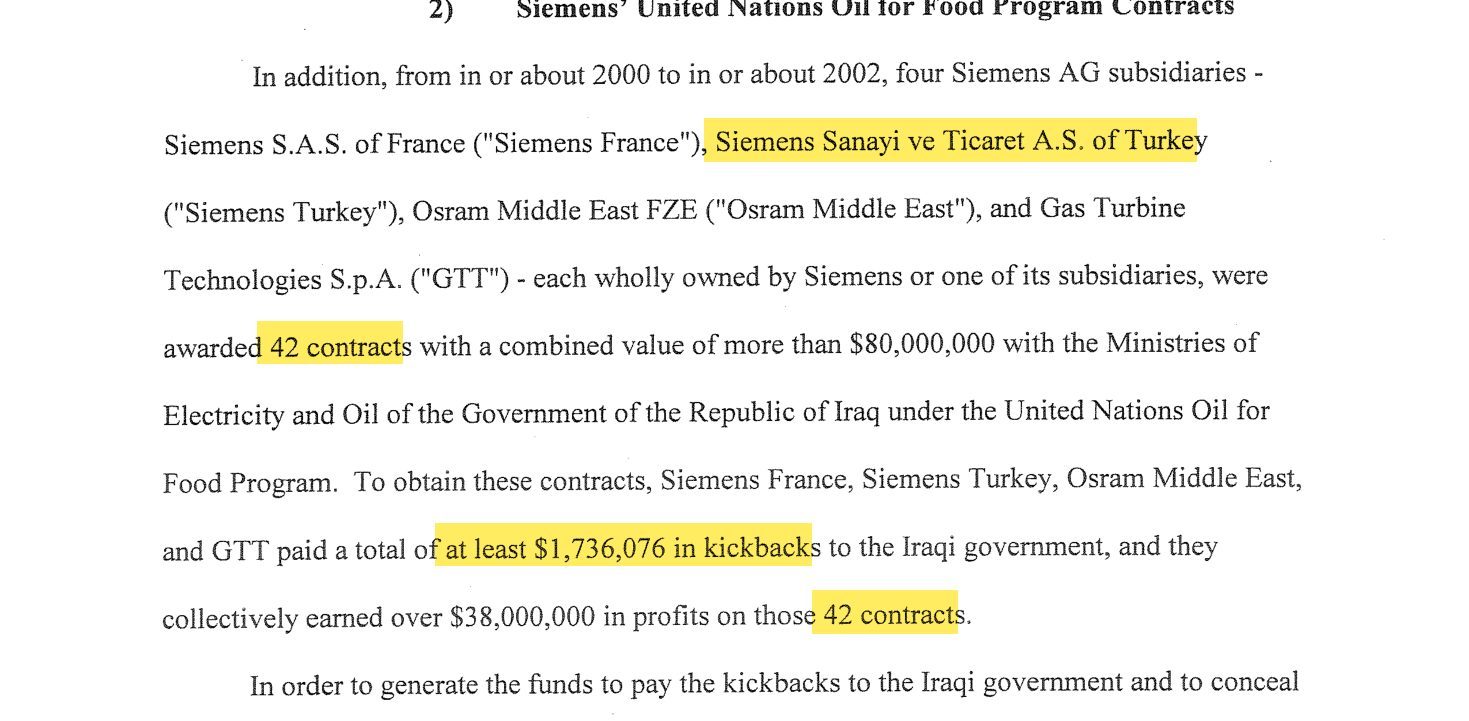
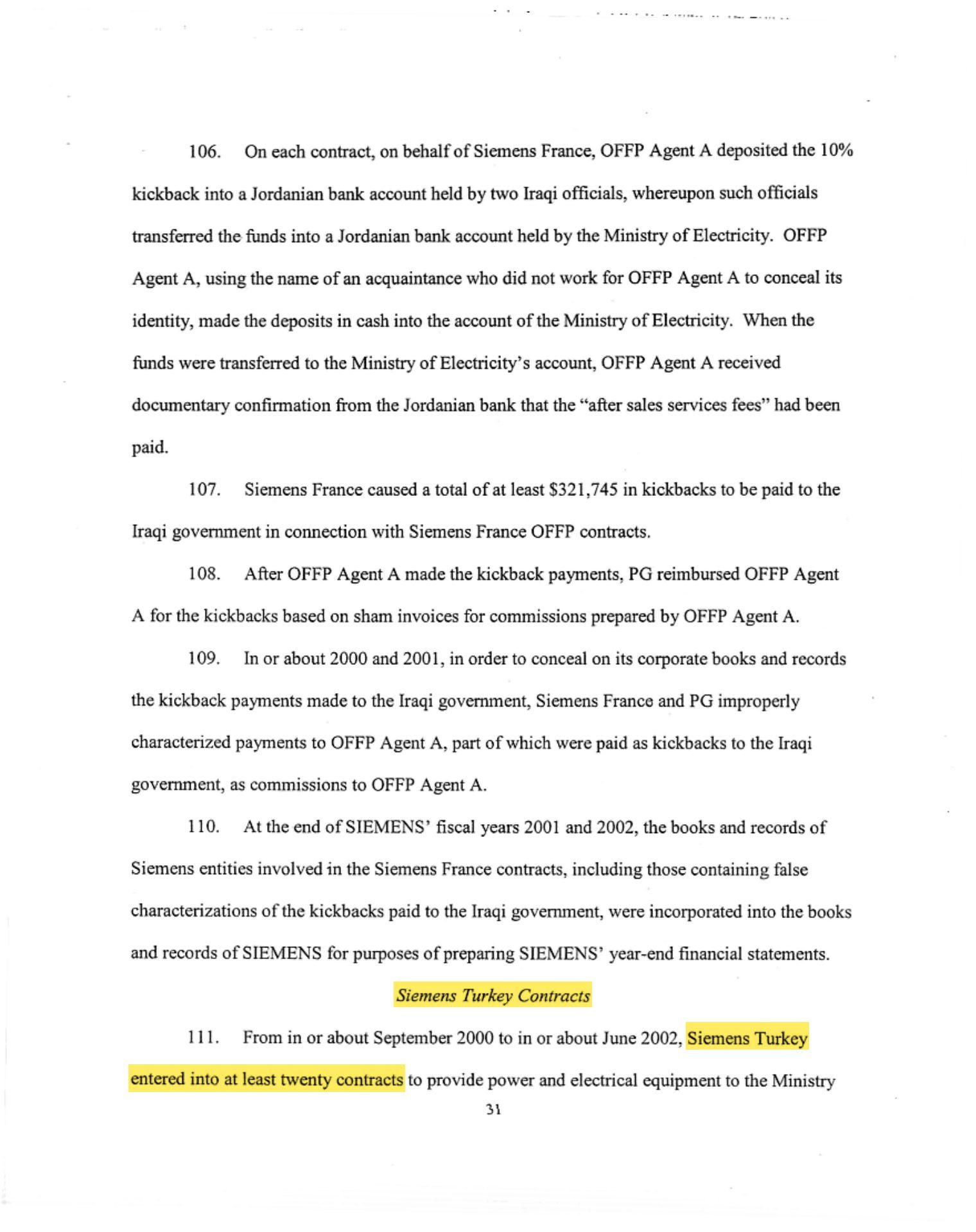
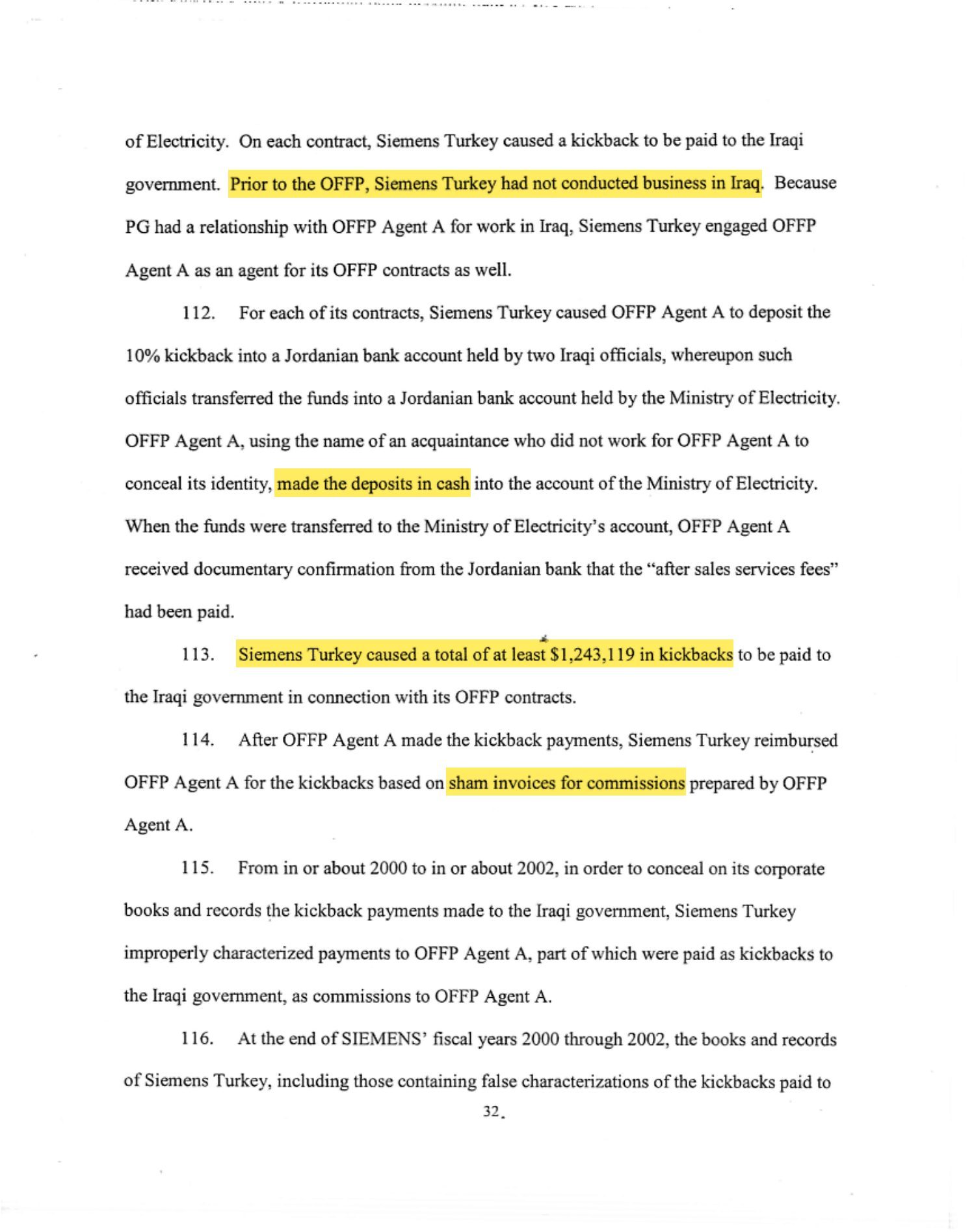
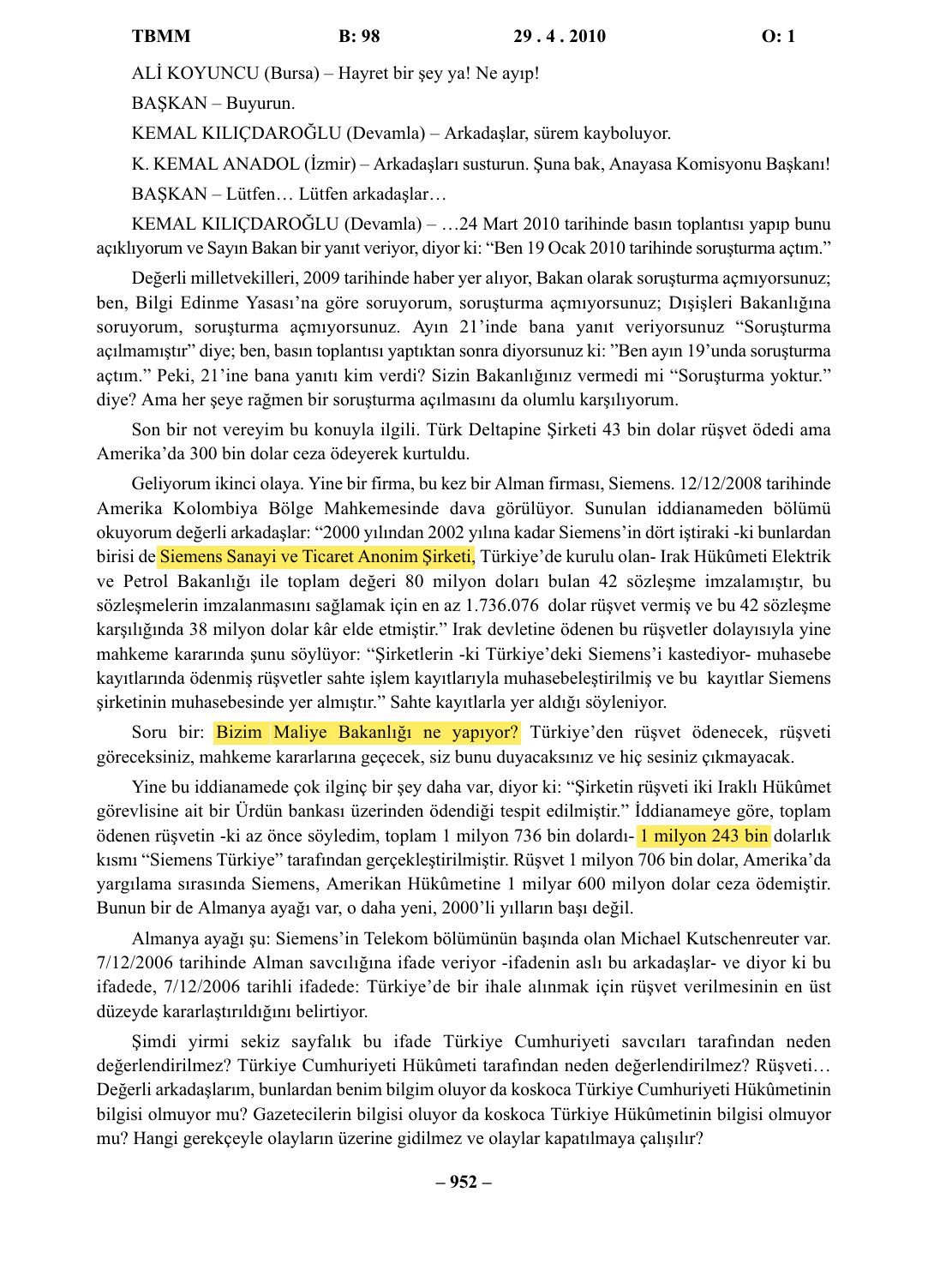
According to that statement, Siemens Turkey entered at least 20 contracts with Iraq’s Ministry of Electricity between September 2000 and June 2002 and caused a kickback to be paid on each. At least US$1,243,119 was paid. The Turkish company accounts for approximately 72% of the US$1,736,076 paid by four Siemens subsidiaries under the Oil-for-Food Programme, and 20 of their 42 contracts.
These records do not establish a bribe to a public official in Türkiye. They establish that a company incorporated in Türkiye arranged systematic payments to a regime under UN sanctions, recorded them as agent commissions, and passed those records into its Munich parent’s consolidated accounts. We found no public record identifying a Turkish authority’s examination of those entries.
The ten-percent price of admission
The Oil-for-Food Programme was designed to feed Iraq’s population after sanctions imposed following the invasion of Kuwait. Oil proceeds were to enter a UN-controlled account, financing food, medicine and infrastructure supplies rather than going directly to Baghdad. The first oil was sold on 10 December 1996. The arrangement continued until the US-led invasion in March 2003.
Suppliers signed contracts with Iraqi ministries and submitted them to the Security Council’s 661 Sanctions Committee. Following approval, BNP Paribas opened a letter of credit through the supplier’s bank. Payment was released once goods entered Iraq and passed UN inspection.
From August 2000, ministries demanded roughly 10% of contract prices as after-sales service fees. Suppliers inflated prices, obtained UN approval and full payment from the escrow account, then covertly returned the difference to the Iraqi government. The Justice Department described the kickbacks as being financed through the UN programme rather than absorbed in suppliers’ profits: money intended for Iraq’s population paid the bill. [1][3]
The Volcker Committee’s final report of 27 October 2005 identified US$1.8 billion in illicit regime revenue and 2,253 companies associated with humanitarian-contract kickbacks. Approximately 139 Turkish companies appeared in the records. Siemens Turkey was among the smaller number examined under a dedicated heading in the main report, with supporting bank records. [2][8]
 Open document at full size
Twenty contracts, one intermediary, one account
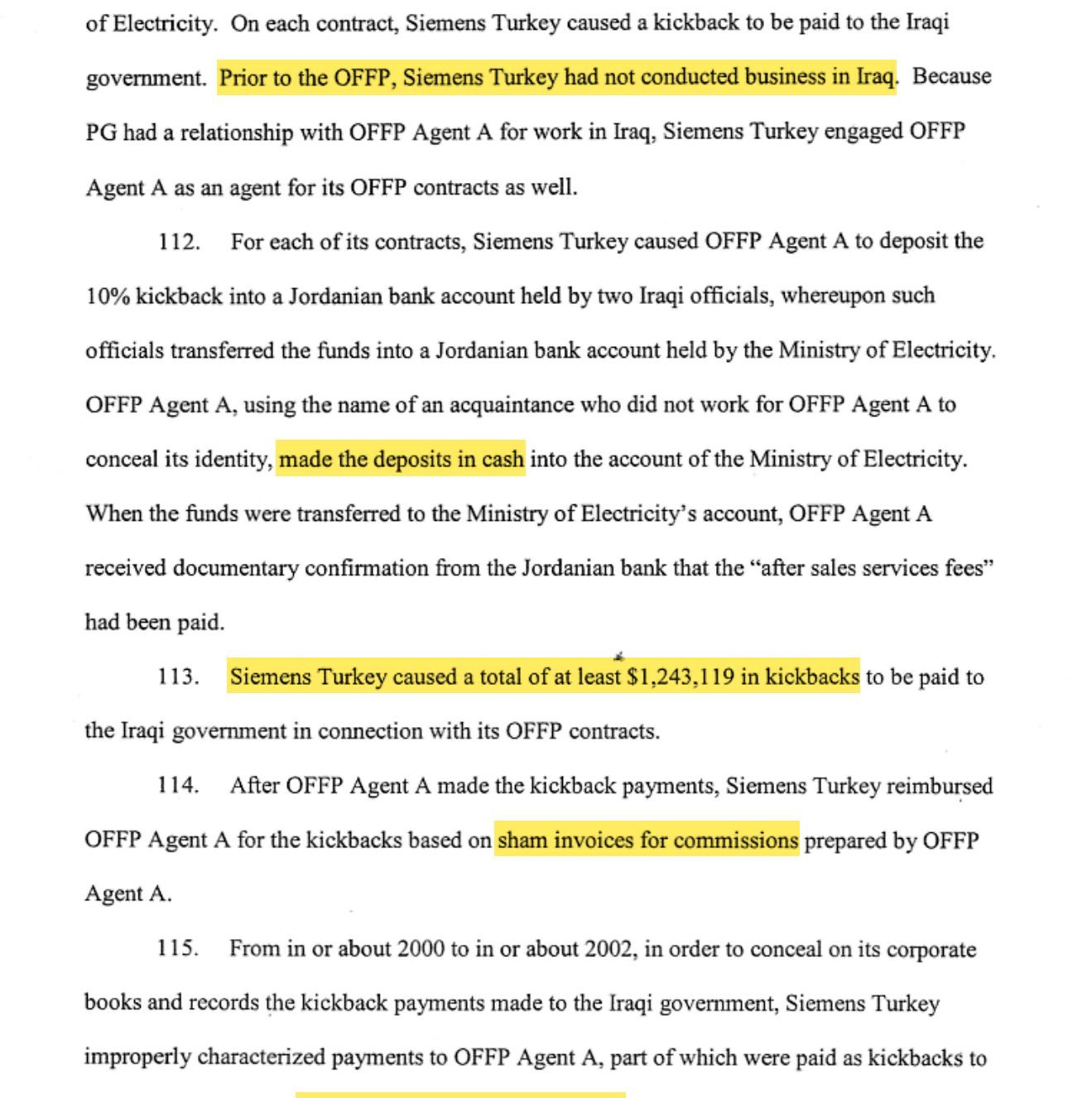
Paragraph 111 of the statement of offense says Siemens Turkey had not done business in Iraq before the programme. Its entry came through an intermediary already used by Siemens’ Power Generation group, PG. Identified as “OFFP Agent A”, it was a Paraguayan company registered in Jordan. Siemens France used the same agent.
Between September 2000 and June 2002, Siemens Turkey contracted to supply power and electrical equipment to the Electricity Ministry. The Volcker report lists switchgear, control and metering systems, circuit breakers and transformers. UN records show about US$77.8 million paid to the company under 13 contracts, more than three fifths of the US$124.3 million received by three Siemens companies in that particular UN accounting. [1][2]
The payment route was repeated: the agent deposited the 10% in cash into a Jordanian account held by two Iraqi officials, who transferred it into the ministry’s account. To conceal its identity, the agent used the name of an acquaintance who did not work for it. The bank then confirmed that the purported after-sales fees had been paid.
 Open document at full size
Deposit slips obtained by the Volcker Committee used the name Dikran Melkon Sarkis for payments associated with both Siemens France and Siemens Turkey. The committee could not locate him and regarded the shared name as suggesting some coordination between the subsidiaries. Under the US account, however, this was a borrowed name; its appearance does not establish the named person’s participation. [1][2]
 Open document at full size
 Open document at full size
The agent subsequently invoiced Siemens Turkey for commissions. The statement of offense calls the invoices sham and says the company improperly recorded payments, partly destined for the Iraqi government, as agent commissions. Those records entered Siemens AG’s consolidated financial statements for fiscal years 2000, 2001 and 2002.
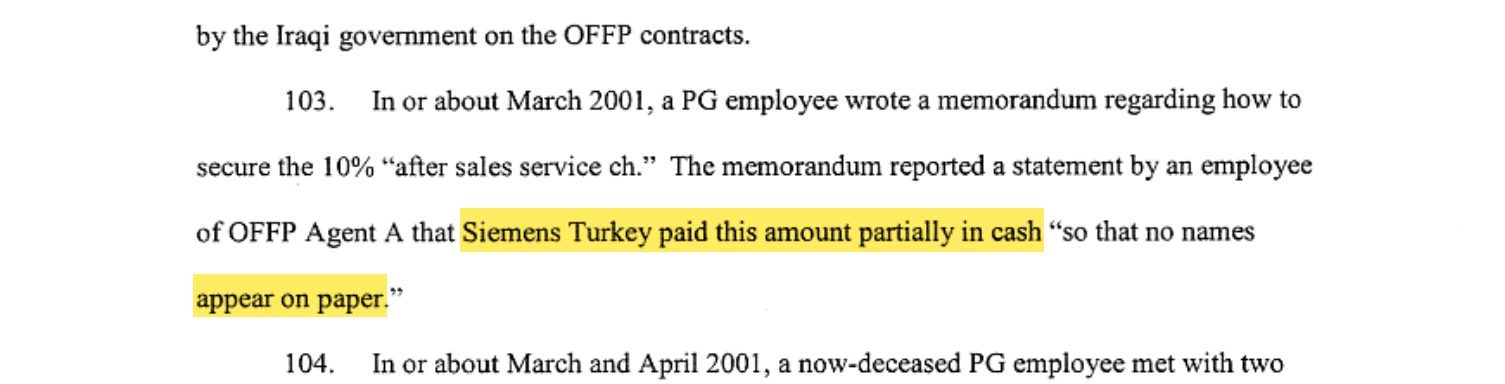
A March 2001 internal memorandum provides the phrase behind this report’s title. A PG employee relayed what an employee of the intermediary had said: Siemens Turkey paid part of the amount in cash to keep names off paper. This is a second-hand account within an internal communication, recorded in paragraph 103 of the statement Siemens accepted. [1][5]
 Open document at full size
| Subsidiary | Contracts | Period | Iraqi counterparty | Kickbacks paid, at least |
|---|---|---|---|---|
| Siemens Turkey (Siemens Sanayi ve Ticaret A.Ş.) | 20 | September 2000 – June 2002 | Ministry of Electricity | US$1,243,119 |
| Siemens France (Siemens S.A.S.) | 12 | January 2000 – April 2001 | Ministry of Electricity | US$321,745 |
| Osram Middle East FZE (UAE) | 6 | February 2000 – June 2002 | Ministry of Oil | US$89,250 |
| Gas Turbine Technologies S.p.A. (Italy) | 4 | June 2001 | Ministry of Electricity | US$81,962 |
| Total | 42 | US$1,736,076 |
Source: Siemens AG statement of offense, paragraphs 98–127. The SEC complaint gives different starting months for Siemens France and Osram, but the same amounts.
The Iraqi ledger was larger still. According to Volcker, the ministry assessed more than US$6.1 million in kickbacks on Siemens Turkey’s 20 contracts and collected over US$1.2 million. No document explains the entire unpaid balance. One contract remained unfulfilled when war began. After the invasion, the UN required Siemens Turkey to reduce that contract’s price by 10%. It complied, although the statement of offense says the kickback had already been paid. [1][2]
The four subsidiaries collectively earned more than US$38 million in gross profits on the 42 contracts. The records do not separately identify Siemens Turkey’s share.
Munich’s slush funds
The US$1.7 million sent to Baghdad was a small entry in the broader Siemens record. Munich prosecutors searched company offices in November 2006. The Justice Department said approximately US$1.36 billion moved through various mechanisms from March 2001 to 2007: US$805.5 million intended wholly or partly as corrupt payments to foreign officials, and US$554.5 million for unknown purposes. [3]
The statement lists off-book accounts, cash desks in company buildings and backdated sham consulting agreements. Signatures on payment approvals were placed on removable sticky notes. The SEC alleged at least 4,283 payments totalling approximately US$1.4 billion in bribes, covering projects including Venezuelan metro systems, Argentine identity cards, a Bangladeshi mobile network, Israeli electricity procurement and Nigerian telecommunications. [1][5]
On 15 December 2008, before Judge Richard J. Leon in the District of Columbia, Siemens AG pleaded guilty to internal-controls and books-and-records violations. Three subsidiaries in Argentina, Bangladesh and Venezuela entered separate guilty pleas.
| Authority | Date | Amount |
|---|---|---|
| US Department of Justice, criminal fines | 15 December 2008 | US$450 million: US$448.5 million for Siemens AG and US$500,000 for each of three subsidiaries |
| SEC, disgorgement | 15 December 2008 | US$350 million |
| Munich prosecutor, non-telecommunications groups | December 2008 | €395 million |
| Munich prosecutor, telecommunications group | October 2007 | €201 million |
| Combined | More than US$1.6 billion |
Source: Justice Department release No. 08-1105. Dollar and euro amounts are separate sanctions; the combined figure is the release’s contemporaneous dollar equivalent. [3]
 Open document at full size
In calculating the sentencing base, prosecutors added US$38 million in profits on Iraqi contracts to US$805.5 million in corrupt payments, reaching US$843.5 million. The sentencing guideline range was US$1.35–2.7 billion. Cooperation contributed to the agreed US$448.5 million fine for Siemens AG. [4]
Two distinctions matter. Siemens Turkey was not a defendant in that criminal case. Siemens AG pleaded guilty to accounting and internal-control offenses; the Turkish subsidiary’s conduct appears in the factual statement accepted by the parent. Separately, Siemens settled the SEC case without admitting or denying its allegations. Details appearing only in the SEC complaint therefore remain allegations, unlike facts accepted in the statement of offense. [1][6]
Iraq also brought civil proceedings in New York against numerous programme suppliers, including Siemens Sanayi ve Ticaret A.Ş. of Turkey. The district court dismissed the case in 2013; the Second Circuit affirmed on 18 September 2014. The court applied the principle that Iraq could not recover for wrongdoing in which its own government had participated by demanding kickbacks. [7]
 Open document at full size
The file Ankara had not heard of
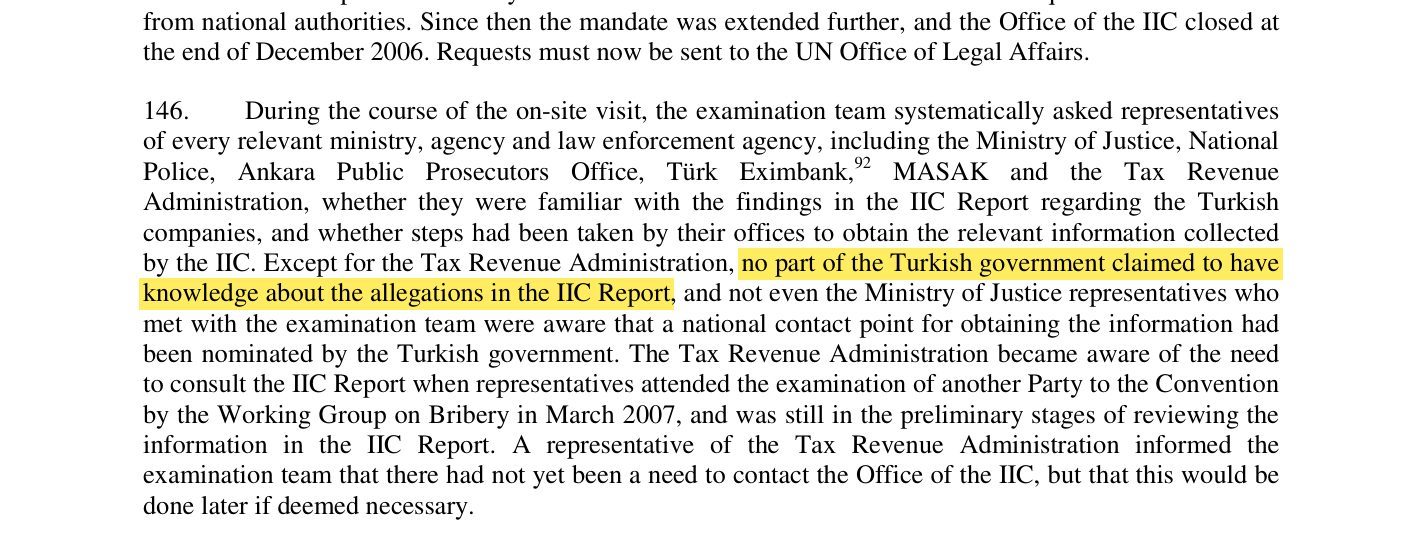
The OECD Working Group on Bribery visited Türkiye in 2007 and asked what had been done about the approximately 139 companies identified by Volcker. Representatives of the Justice Ministry, police, Ankara chief prosecutor and financial-intelligence unit MASAK were unaware of the report. Justice Ministry representatives did not even know their ministry had appointed a contact for the UN committee. Only the Revenue Administration knew of the matter; its examination was at an initial stage. The examiners recorded disappointment and surprise. Turkish authorities said the topic had been added to the visit agenda at short notice. [8]
 Open document at full size
The October 2014 Phase 3 report recorded that only two firms had been prosecuted. Ankara’s 7th Aggravated Court acquitted them; the Court of Cassation upheld the acquittal on 14 February 2013. Foreign bribery had become an offense in Turkish law only when Law No. 4782 entered into force on 11 January 2003. The relevant conduct predated it. [8][9]
 Open document at full size
Siemens Turkey’s contracts date from September 2000 to June 2002; the last documented receipt is from December 2002. The payments described in the US records therefore preceded Türkiye’s foreign-bribery offense. The OECD does not identify the two prosecuted firms. We do not know whether Siemens Turkey was one of them.
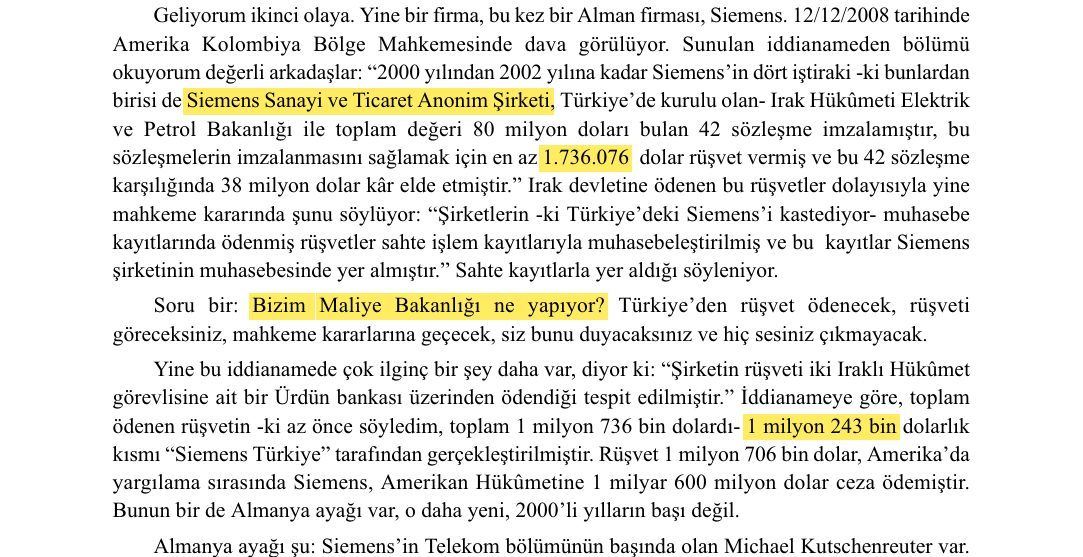
That historical criminal-law obstacle did not answer questions about sanctions or accounting. US prosecutors described sham invoices recorded as expenses by a Turkish company. During a parliamentary censure debate concerning Prime Minister Erdoğan on 29 April 2010, CHP politician Kemal Kılıçdaroğlu read the Siemens Turkey figures and asked what the Finance Ministry was doing. The governing party’s response recorded in the transcript did not answer that accounting question. [10]
 Open document at full size
The sitting also shows how distinct matters became conflated. Kılıçdaroğlu described the US document as evidence of bribery distributed in Türkiye; it did not establish that. AKP MP Cüneyt Yüksel interjected with the dates 2000–2002. Speaking for the government, Nurettin Canikli said the Siemens matters had reached the courts and cited a case opened before Ankara’s 11th Aggravated Court in 2007. According to his account, a defendant had put Siemens allegations into that case’s hearing record. He did not establish that the Iraqi payments were being examined there. [10]
Three stories are routinely grouped under the Siemens file in Türkiye. The first is the documented Iraqi payments accepted by Siemens AG, involving Iraqi rather than Turkish officials.
The second concerns military communications procurement. Press accounts attribute it to former Siemens telecommunications finance executive Michael Kutschenreuter’s statement to Munich prosecutors on 7 December 2006. In August 2008, Milliyet columnist Metin Münir reported allegations of senior-level discussion of bribery over an approximately €150 million TAFICS contract, a consulting agreement with Monaco-based businessman Tonio Arcaini and a meeting with an unnamed minister in Ankara. Arcaini denied bribing anyone or securing a ministerial appointment for Siemens; the defence procurement authority denied the allegation. Sözcü reported in 2015 that the Prime Ministry’s inspection board found nothing and Ankara prosecutors declined prosecution on 24 September 2012, regarding the allegations as abstract and general. A German judicial-assistance request reportedly was returned as incomplete and not renewed. This section rests on press accounts; this investigation has not independently verified the original testimony or decision. [11][12][14]
The third concerns BOTAŞ. Businessman Rubil Gökdemir, a defendant in the Mavi Hat energy-procurement case, alleged Siemens also paid bribes in Türkiye and filed a complaint. CNN Türk reported on 3 March 2009 that prosecutors declined prosecution, partly because Energy Minister Hilmi Güler had not authorised an investigation of three BOTAŞ managers. Güler said the legal process was continuing without explaining his refusal. The later press figure of €57 million in Turkish bribes derives from this defendant’s allegation; we have not established its confirmation in a court judgment. [13]
The second and third stories were allegations closed without prosecution, according to those accounts. The first is supported by accepted facts, yet we found no public record naming a Turkish examination of it. Siemens Turkey’s historical response, reported in August 2008, was that no legal investigation or allegation had reached it. That is a response from that period, not a new statement obtained for this publication. [12]
What is established, and what is not
| Information | Status | Basis |
|---|---|---|
| At least 20 Siemens Turkey contracts in 2000–2002, kickbacks on each, at least US$1,243,119 paid | Accepted facts | Statement of offense, paragraphs 111–116 |
| Cash deposits in Jordan and sham commission invoices entered in the books | Accepted facts | Paragraphs 112–115 |
| More than US$6.1 million assessed and US$1.2 million collected; Simko deposit notation and US$20,000 receipt | UN inquiry findings | Volcker, page 379, footnote 690 |
| Cash used to keep names off paper | Second-hand internal account | Statement paragraph 103; SEC complaint paragraph 69 |
| Total for 42 contracts | Sources use different measures | DOJ: over US$80 million in contract value; SEC: over US$124 million in revenue |
| Currency of the 500,000 deposit on 1 May 2002 | Inconsistent | Volcker main text: dollars; footnote 690: euros |
| Bribery discussed for military communications procurement and a meeting with a minister | Allegation; press reports say prosecution was declined | Reported testimony and decision of 24 September 2012 |
| €57 million in bribes within Türkiye | Unverified defendant’s allegation | Mavi Hat press reporting |
| An Iraqi-contract payment to a Turkish public official | Not in the records examined | US and UN records concern payments to Iraq’s government |
| Who approved payments or signed invoices in Türkiye? | Unknown | Records do not name them |
| Identity of OFFP Agent A | Unknown | Described only as a Paraguayan company registered in Jordan |
| Turkish tax or prosecution inquiry; whether Siemens Turkey was one of the two OECD firms | Unknown | No public record located |
| Outcomes of Siemens-related Oil-for-Food inquiries in Germany and France | Not verified | No verified outcome established in this file |
Questions still to be asked
More than twenty years have passed. A public question remains: did Turkish authorities ever examine these books, when a system documented by the UN and US and accepted by the parent company passed through the accounts of a Turkish corporation? Four institutions can provide answers.
For Siemens Turkey
- Were the payments in paragraphs 111–116 investigated internally? When, and with what result?
- Were managers approving the payments or processing the agent’s invoices disciplined?
- Were amended tax returns filed for expenses booked as commissions, or settlements reached with the tax authority?
- Did the company provide information to Volcker in 2005? Were Turkish records reviewed before the parent challenged the committee’s conclusions?
- Did any Turkish authority request information or documents on this matter?
For the Treasury and Finance Ministry
Were the company’s 2000–2002 accounts examined after the 2005 UN report or the 2008 US resolution? What became of the Revenue Administration review described to OECD examiners in 2007 as being at an initial stage?
For the Justice Ministry
Which two of the approximately 139 firms were prosecuted? What steps were taken concerning the others? What documents were requested from and received through the UN Office of Legal Affairs?
For Ankara’s chief prosecutor
Did the decision of 24 September 2012 cover the Iraqi payments, or only allegations attributed to Kutschenreuter’s testimony?
Further documentary avenues include the 2000–2002 Turkish trade-register records identifying authorised company representatives; the Ankara court judgment and its appellate affirmation identifying the two prosecuted firms; and the Volcker Committee’s company schedules and underlying records held by the UN Office of Legal Affairs.
Document appendix: full-page images
The following images reproduce source-document pages. Yellow highlighting is by The Ledgers. Click an image to open it at full size.
 Open document at full size
 Open document at full size
 Open document at full size
 Open document at full size
 Open document at full size
 Open document at full size
 Open document at full size
Source documents
14- DOJ — Siemens AG Statement of Offense, paragraphs 98–127justice.gov
- UN Independent Inquiry Committee — Volcker report, 27 October 2005, pages 375–380files.ethz.ch
- DOJ — coordinated Siemens resolution, 15 December 2008justice.gov
- DOJ — Department’s Sentencing Memorandumjustice.gov
- SEC — Siemens complaint, 12 December 2008, paragraphs 67–71sec.gov
- SEC — Litigation Release 20829, 15 December 2008sec.gov
- US Second Circuit — Republic of Iraq v. ABB AG, 18 September 2014ww3.ca2.uscourts.gov
- OECD — Turkey Phase 2 report, December 2007, paragraphs 15 and 145–147oecd.org
- OECD — Turkey Phase 3 report, adopted 17 October 2014, paragraphs 25–26one.oecd.org
- Turkish Parliament — proceedings, 29 April 2010, page 952 and followingwww5.tbmm.gov.tr
- Milliyet / Metin Münir — historical allegations, 1 August 2008 (press account)milliyet.com.tr
- Milliyet / Metin Münir — historical allegations and response, 27 August 2008 (press account)milliyet.com.tr
- CNN Türk — BOTAŞ investigation permission and declined prosecution, 3 March 2009 (press account)cnnturk.com
- Sözcü / Asuman Aranca — military procurement file, 3 February 2015 (press account)sozcu.com.tr
File updates
Report published
Editorial note
The publications used in this account are listed above.
Submit a response or correctionReader comments
Verified members can comment. Comments appear after editorial approval. Please address the evidence and avoid personal information.
No published comments yet.
Sign in / Create account →Stay with the story.
Follow The Ledgers for new investigations, developments in our case files and videos.
Choose The Ledgers in Google’s source preferences. Availability is determined by Google.