Investigation teaser
Open videoThe Ledgers investigation teaser. The video is in English.
The parties to the $9.3 billion contract
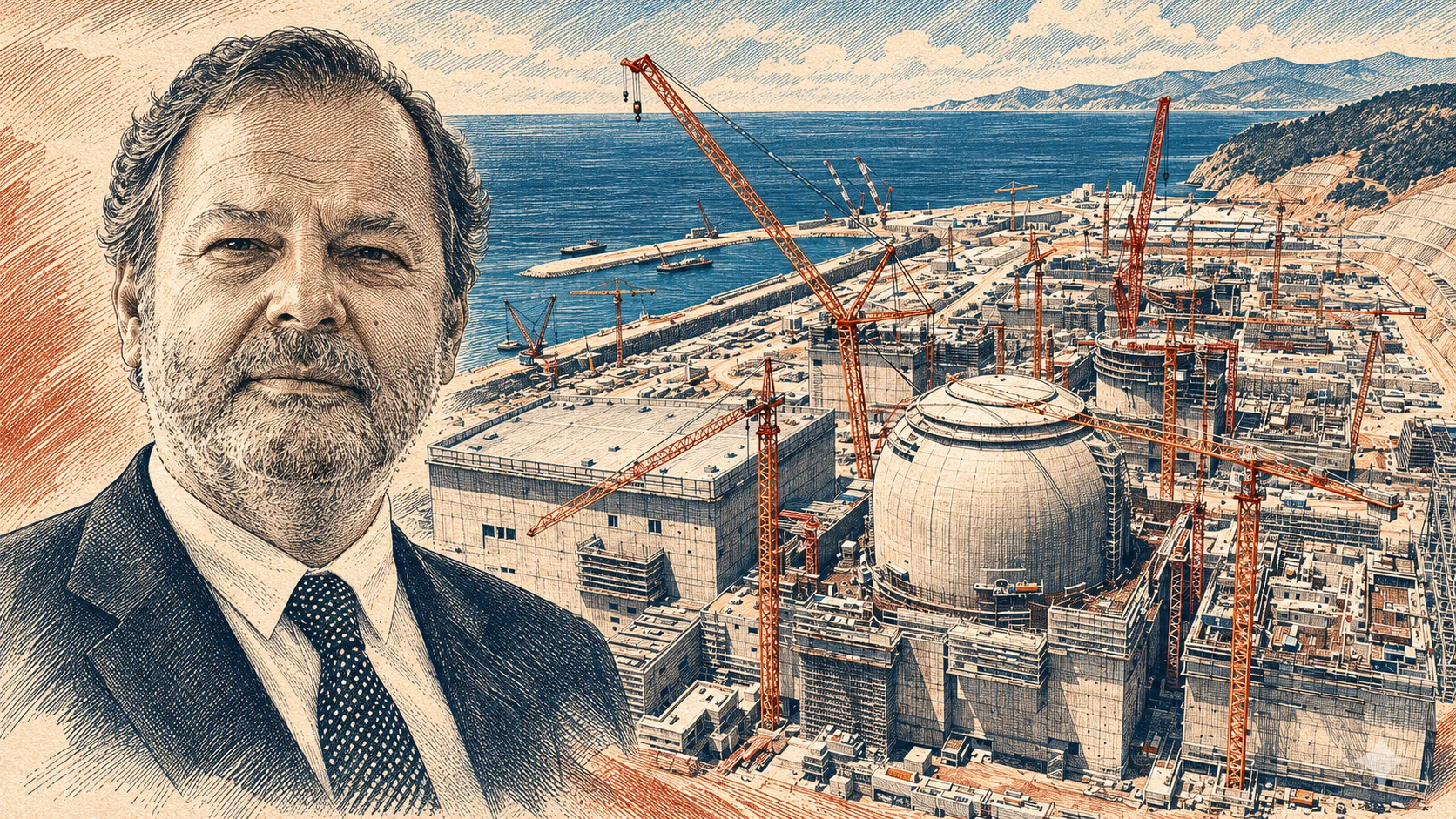
On 23 July 2019, a signing ceremony took place at the Akkuyu construction site in Gülnar, in the province of Mersin. Energy Minister Fatih Dönmez and Rosatom Director General Alexey Likhachev were there. According to Anadolu Agency’s report that day, the agreement covered the plant’s design, equipment procurement and construction. In a 3 June 2024 interview with IC Holding CEO Murad Bayar, Reuters put the value of the engineering, procurement and construction contract at $9.3 billion.
The client was the plant’s owner, Akkuyu Nükleer A.Ş. The contractor was a joint venture formed two and a half months earlier, Titan2 IC İçtaş İnşaat. Half belonged to Russia’s Titan-2 and half to IC İçtaş, founded by İbrahim Çeçen. Grigoriy Naginskiy of Titan-2 and Fırat Çeçen of İçtaş signed for the contractor.
That day, one Turkish citizen sat on the client’s board: Cüneyd Zapsu, a founding member of the AK Party and a former adviser to Erdoğan. The press called him the “only Turkish member.”
Records reviewed by The Ledgers show that Zapsu’s consultancy had billed IC İçtaş 12.68 million lira the year before.
Two other names appear in the same records: RAOS Energy, a Rosatom company in Türkiye, and Akkuyu Nuclear itself. Zapsu’s company appears to have billed both the client and the Turkish partner in the joint venture the client selected as its contractor.
The records do not establish a crime. Providing consultancy services and hiring a consultant are both legal. But they raise a question that has yet to be answered: if a company belonging to a member of the client’s board billed the contractor, who knew?
What the records show
The company that issued the invoices bears Zapsu’s name: Cuneyd Zapsu Danışmanlık A.Ş. On 19 October, The Ledgers reported on invoices worth 19.6 million lira that the company issued to Switzerland’s SICPA group between 2015 and 2019. The same records now lead to Akkuyu. They cover the years 2015 to 2020.
| Company billed | Approximate amount |
|---|---|
| IC İçtaş İnşaat, 2015 | $1.69 million |
| IC İçtaş İnşaat, 2016 | $0.97 million |
| IC İçtaş İnşaat, 2018 | $2.63 million (12.68 million lira) |
| RAOS Energy | $3.4 million |
| Akkuyu Nükleer A.Ş. | $1.2 million |
| Total | About $9.9 million |
Dollar equivalents were calculated using the average exchange rate for the year in which the amounts were invoiced.
There is a limit to what the records show. We have annual totals of the amounts the company billed each client, rather than the underlying invoices. The records do not show whether the money was collected or which services it covered.
“On the recommendation of the Russian side”
For years, Zapsu’s role at Akkuyu was summed up in the same two words: “only Turk.” In August 2017 he corrected that description in an interview with Habertürk columnist Serpil Yılmaz: “I joined the board on the recommendation of the Russian side, not Türkiye.”
According to the same article, Zapsu had been a senior adviser to Rosatom since 2016. He had first served for one year on Akkuyu Nuclear’s board in 2013–2014. As Hürriyet reported at the time, on 17 February 2017 the board appointed him again to replace Karina Tsurkan, who had resigned. The general assembly approved the appointment on 31 March.
About three weeks after the board appointment, on 9 March 2017, a new company was incorporated in Istanbul’s Beyoğlu district: RAOS Energy Enerji Yatırımları Danışmanlığı A.Ş. Rosatom describes it as part of the group’s Rusatom Energy International business, with responsibility for promoting Rosatom products in Türkiye.
Since RAOS was founded in 2017 and the records end in 2020, the amounts Zapsu’s company billed RAOS fall within those four years. Zapsu sat on Akkuyu Nuclear’s board throughout that period.
The third name in the records is even closer to home: Akkuyu Nuclear itself. Zapsu’s company appears to have billed it directly in 2020, when he was on its board. Akkuyu Nuclear’s total in the records is approximately $1.2 million.
A Rosatom adviser billing Rosatom companies is hardly surprising in itself. Zapsu made no secret of his advisory role. But the law has specific rules for dealings between a board member’s company and the company on whose board that person sits. Two further details were missing from the public record we could find: the amounts and the identity of the other client.
The invoice and the contract, a year apart
Two of the three amounts billed to IC İçtaş date to 2015 and 2016, when Zapsu was not on the board. At the time, İçtaş and Italy’s Astaldi were working on a €2.2 billion motorway project in St Petersburg. They had recently completed the expansion of the city’s Pulkovo Airport. The invoices may have related to those projects, or to something else entirely.
The 2018 invoice came at a different point. Zapsu was then on the board of Akkuyu Nuclear and had said a year earlier that he was a senior adviser to Rosatom. His company billed İçtaş 12.68 million lira, the largest amount of the three years. We do not know what service it covered and have no document linking it to Akkuyu.
On 9 May 2019, İçtaş and Titan-2 formed their joint venture. Two and a half months later it signed the contract with Akkuyu Nuclear, on whose board Zapsu sat.
We do not know whether the board considered the contract. If it did, we do not know whether Zapsu took part in the discussion or vote, or whether he disclosed his relationship with İçtaş to the board.
The Turkish Commercial Code sets out two rules for situations of this kind. Under Article 393, a board member may not take part in deliberations on matters in which their personal interests conflict with the company’s. Under Article 395, a member may not transact with the company, on their own or anyone else’s behalf, without permission from the general assembly. Since Zapsu’s company billed Akkuyu Nuclear in 2020 while he was on its board, the second rule is directly relevant. We do not know whether the general assembly granted permission. Joint-stock companies often grant it routinely each year. If permission was given, the transaction would not breach that rule.
A termination, reports of a resignation and a lawsuit
Three years later, the client and contractor fell out.
Akkuyu Nuclear terminated its contract with the joint venture on 26 July 2022. Four days later it announced that it had awarded the work to a company called TSM Enerji. Rosatom alleged that İçtaş had committed numerous breaches affecting the quality and schedule of the work. İçtaş called the termination unlawful and invalid. It said TSM belonged to Titan-2 and that the real aim was to reduce the number of Turkish companies on the project.
President Erdoğan visited the construction site on 9 August. Around the same time, reports circulated that Zapsu had resigned. Habertürk columnist Fatih Altaylı wrote that Zapsu had told people close to him he could not accept what had happened. When journalist Murat Yetkin called, Zapsu declined to comment.
On 16 September, Erdoğan and Putin met in Samarkand. Putin said the problems had been resolved. İçtaş returned to the project.
Three weeks later Zapsu spoke, this time through the courts. In a petition dated 5 October 2022, he sued the company on whose board he sat in Ankara’s Ninth Commercial Court of First Instance. According to Medyascope’s account of the petition, he had been unable to obtain information and documents, his requests for in-person meetings had gone unanswered, and he had placed a formal objection on record concerning a radar system proposed for the plant.
The petition raised another issue: İçtaş’s removal and subsequent reinstatement on the same terms. It argued that this decision had cost the company about $2 billion.
The opposition took the case to parliament. Ali Mahir Başarır of the Republican People’s Party (CHP) read Zapsu’s objection to the radar system on the floor. A motion for a parliamentary inquiry was defeated by votes from the AK Party and its Nationalist Movement Party (MHP) ally. On 19 December 2022, the Trade Registry Gazette published the names of Akkuyu Nuclear’s new board. Zapsu’s name was absent.
One fact was missing from the public debate at the time. The company belonging to the board member who challenged the client’s decisions in its dispute with the contractor had billed the contractor’s Turkish partner more than $5 million.
Zapsu may have been right to object. The termination may indeed have cost the company dearly, and the radar may have posed a genuine risk. But when a board member takes a decision between the client and contractor to court, should the court and the public not also know about the invoices between his company and the contractor’s Turkish partner?
We were unable to find any public information on the outcome of the lawsuit.
What Akkuyu means to İçtaş
Akkuyu is a substantial business for İçtaş. According to its audited financial statements, its sales to the joint venture came to 3.97 billion lira in 2022, 11.10 billion in 2023 and 9.12 billion in the first six months of 2024. These figures represent İçtaş’s sales to the joint venture. The plant’s contract value is a separate figure. The financial statements are inflation-adjusted, so the three amounts cannot be added together.
The plant is now preparing to start up its first reactor. On 6 November, Energy Minister Alparslan Bayraktar said the target was December. According to Rosatom’s timetable, fuel will be loaded in December and the plant will generate its first electricity in January or February 2027.
When the reactor starts up, the Akkuyu ledger will still be open. One of its pages records the invoices between a company belonging to a member of the client’s board and the contractor’s Turkish partner.
Is that the full picture?
The records end in 2020. Construction continued, the dispute broke out in 2022 and Zapsu left the board at the end of that year. These records cannot tell us what happened in the intervening or subsequent years.
There is another limitation. These are the domestic records of a Turkish company. They would not show invoices issued by an overseas company or an economic benefit that did not take the form of an invoice.
We have no document showing that any such payment or benefit existed. Nor can these records establish whether the $9.9 million represents the full extent of the relationship. That is why we are putting the question directly to the parties.
What we know and what we don’t
| Issue | What we know | What we don’t know |
|---|---|---|
| İçtaş invoices | $5.29 million in total in 2015, 2016 and 2018 | The services covered, any connection to Akkuyu and whether the money was collected |
| Rosatom companies | $3.4 million billed to RAOS Energy and $1.2 million to Akkuyu Nuclear. The Akkuyu Nuclear entry dates to 2020, when Zapsu was on its board | Which contract the billing was based on and whether the general assembly gave permission |
| The 2019 contract | Zapsu was on the client’s board at the time | Whether the decision came before the board, whether Zapsu voted and whether he disclosed his relationship with İçtaş |
| The 2022 lawsuit | The petition described İçtaş’s removal and reinstatement as a $2 billion loss | Whether the court was told about the billing between Zapsu’s company and İçtaş, and how the case ended |
| After 2020 | The records end in 2020. Zapsu remained on the board until December 2022 | Whether there were other payments or economic benefits in subsequent years, through overseas companies or outside the invoicing records |
The Ledgers asks
We are putting the following questions to the people and institutions concerned. We will publish their replies as received.
To Cüneyd Zapsu
1. What services did your company bill IC İçtaş for in 2015, 2016 and 2018? Were they connected to the Akkuyu project?
2. Did you disclose your relationship with IC İçtaş to the board of Akkuyu Nuclear and to Rosatom? If the 2019 contract came before the board, did you take part in the discussion or the vote?
3. Which contract formed the basis for the amounts billed to RAOS Energy and Akkuyu Nuclear? Did the general assembly authorise you to do business with Akkuyu Nuclear in 2020, while you were a member of its board?
4. In the lawsuit you filed in 2022, you described İçtaş’s removal and reinstatement as a loss to the company. Did you tell the court about your company’s invoices to İçtaş?
5. Does the approximately $9.9 million in the records represent the full extent of your relationship with these companies? After 2020, or through an overseas company, did you receive any fee, bonus or other economic benefit from the IC group, Titan-2, the joint venture or any Rosatom company?
6. Apart from consultancy fees, was any economic benefit provided through share transfers, transfers of real estate or other assets?
7. Were alternative methods of payment used, including cryptoassets?
To IC Holding
8. What services did you obtain from Zapsu’s company? Did the contract provide for a payment contingent on winning the work?
9. Did you disclose this relationship to your partner, Titan-2, and to your client, Akkuyu Nuclear?
To Akkuyu Nuclear, RAOS Energy and Rosatom
10. Did you know that a company belonging to a member of your board had billed the Turkish partner in the main contracting joint venture? Did you obtain a conflict-of-interest declaration from him?
11. Which services did RAOS Energy and Akkuyu Nuclear pay Zapsu’s company for, and how much did they pay in total? Did the general assembly authorise the 2020 transaction?
To the Ministry of Energy and Natural Resources
12. The ministry was represented at the 2019 signing ceremony and intervened between the parties during the 2022 dispute. Was it aware of this relationship between a member of the client’s board and the contractor?
Timeline
| Date | What happened | Source |
|---|---|---|
| 2013–2014 | Zapsu served for one year on Akkuyu Nuclear’s board | Habertürk |
| 2015 and 2016 | Zapsu’s company billed IC İçtaş $1.69 million and $0.97 million respectively | Records reviewed by The Ledgers |
| 2016 | By his own account, Zapsu became a senior adviser to Rosatom | Habertürk |
| 17 February 2017 | The board reappointed Zapsu. The general assembly approved the appointment on 31 March | Hürriyet, Habertürk |
| 9 March 2017 | RAOS Energy was incorporated in Istanbul | Registry data |
| 2018 | Zapsu’s company billed IC İçtaş 12.68 million lira | Records reviewed by The Ledgers |
| 9 May 2019 | Titan2 IC İçtaş İnşaat was formed | Company website |
| 23 July 2019 | A signing ceremony was held for the contract between Akkuyu Nuclear and the joint venture | Anadolu Agency |
| 2020 | Zapsu’s company billed Akkuyu Nuclear while he was on its board | Records reviewed by The Ledgers |
| 26 July 2022 | Akkuyu Nuclear terminated the contract. On 30 July it announced TSM Enerji as the new contractor | Bloomberg HT |
| 9–10 August 2022 | Reports said Zapsu had resigned. He declined to comment | Yetkin Report, Yeşil Gazete |
| 16 September 2022 | Erdoğan and Putin met. İçtaş returned to the project | NEI Magazine |
| 5 October 2022 | Zapsu sued Akkuyu Nuclear | Medyascope, ANKA |
| 19 December 2022 | The new board was announced. Zapsu was not on the list | Medyascope |
| November 2026 | December was announced as the target for starting up the first reactor | Anadolu Agency, via Memurlar.net |
Sources
Records reviewed by The Ledgers
- Records covering 2015–2020 relating to amounts billed by Cuneyd Zapsu Danışmanlık A.Ş. to IC İçtaş İnşaat, RAOS Energy and Akkuyu Nuclear.
Documents and company sources
- IC İçtaş İnşaat, audited financial statements
- RAOS Energy Enerji Yatırımları Danışmanlığı A.Ş., registry data
- Rosatom, NPPES 2023 press release, June 2023
- Titan2 IC İçtaş İnşaat, company profile
- Astaldi project pages: Pulkovo Airport and the St Petersburg motorway
- Turkish Commercial Code, Law No. 6102, Articles 393 and 395
Press
- Anadolu Agency, 23 July 2019
- Hürriyet (Neşe Karanfil), February 2017
- Habertürk (Serpil Yılmaz), 22 August 2017
- Bloomberg HT, 30 July 2022 and 1 August 2022
- Yetkin Report (Murat Yetkin), 10 August 2022
- Yeşil Gazete, 10 August 2022, reporting on Fatih Altaylı’s column in Habertürk
- NEI Magazine, 20 September 2022
- ANKA, 26 October 2022
- Medyascope, 1 November 2022 and 20 December 2022
- Milli Gazete, 22 December 2022
- Anadolu Agency, via Memurlar.net, 6 November 2026
- Mersin Portal, 15 November 2026, on the Rosatom director general’s statement to TASS
- Reuters, 3 June 2024, via MarketScreener
File updates
Report published
Reader comments
Verified members can comment. Comments appear after editorial approval. Please address the evidence and avoid personal information.
No published comments yet.
Sign in / Create account →Stay with the story.
Follow The Ledgers for new investigations, developments in our case files and videos.
Choose The Ledgers in Google’s source preferences. Availability is determined by Google.