Investigation teaser
Open videoThe Ledgers investigation teaser. The video is in English.
The record
“In order for us to bid, the tender … was canceled”
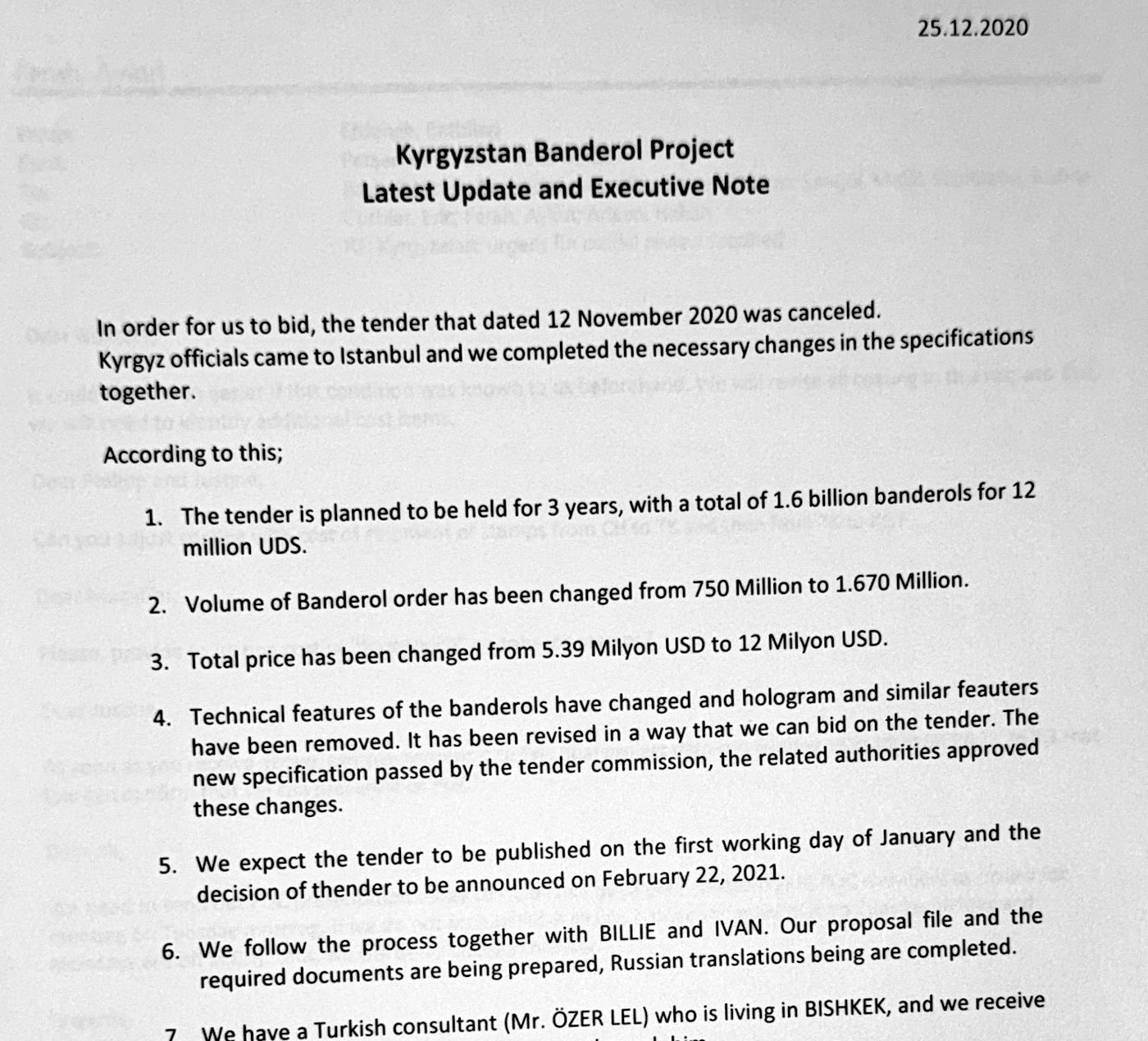
25 December 2020. A one-page note prepared by SICPA Turkey carried an unremarkable heading: “Kyrgyzstan Banderol Project, Latest Update and Executive Note.” Its opening was anything but routine:
“In order for us to bid, the tender that dated 12 November 2020 was canceled. Kyrgyz officials came to Istanbul and we completed the necessary changes in the specifications together.”
 Open document at full size
This is the account SICPA Turkey gave its own management: a public tender cancelled so that the company could participate, followed by specifications revised with Kyrgyz officials in Istanbul. It is an internal corporate account, not an independently established explanation by the procurement authority. The distinction matters. So does the specificity of what the note records.
The proposed quantity had risen from 750 million stamps to 1.67 billion, and the stated contract value from US$5.39 million to US$12 million. A hologram requirement had been removed. The note supplied its own explanation: “It has been revised in a way that we can bid on the tender.”
Four days later, the general manager forwarded the update to SICPA executive Eric Corbier in Switzerland. The greeting was “Dear Brother.” Corbier replied in the same familiar register: “Good morning my brother. This will be done for sure.”
 Open document at full size
 Open document at full size
The final item in the executive note introduced the consultant who would become central to the dispute: Özer Lel, a Turkish consultant living in Bishkek. The note said the team received daily updates from him.
Beyond winning the tender: a plan to remove it
Three months later, the correspondence described a different route. Rather than simply compete for the tender, SICPA staff considered how the work could be channelled through a state enterprise.
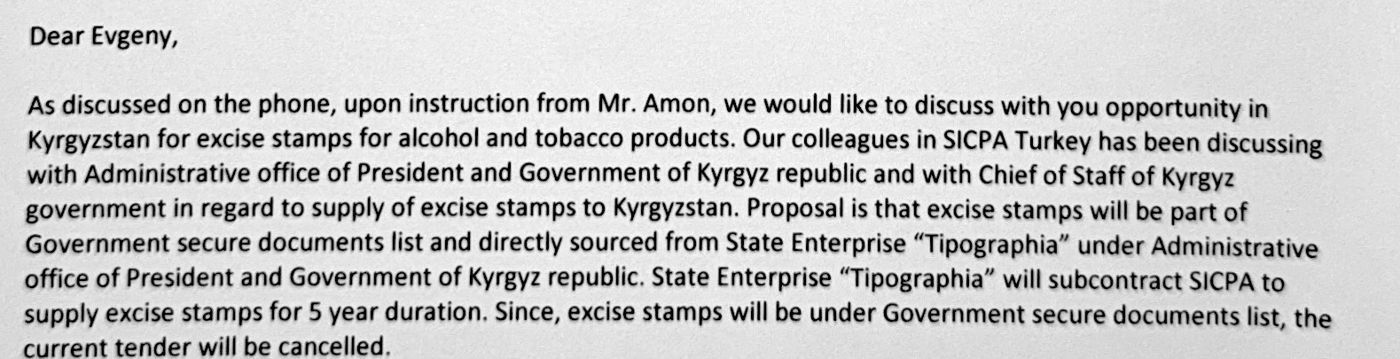
On 6 April 2021, Batbileg Erdenee, SICPA’s business development director in Lausanne, emailed Evgeny Matveev of the company’s Russian team. Philippe Amon, SICPA’s owner and senior executive, appeared in the copy line. Erdenee opened with “upon instruction from Mr. Amon.” That wording attributes an instruction to Amon; the copy line alone cannot establish what he read or approved.
The proposal followed:
“Proposal is that excise stamps will be part of Government secure documents list and directly sourced from State Enterprise ‘Tipographia’ […] State Enterprise ‘Tipographia’ will subcontract SICPA to supply excise stamps for 5 year duration. Since, excise stamps will be under Government secure documents list, the current tender will be cancelled.”
 Open document at full size
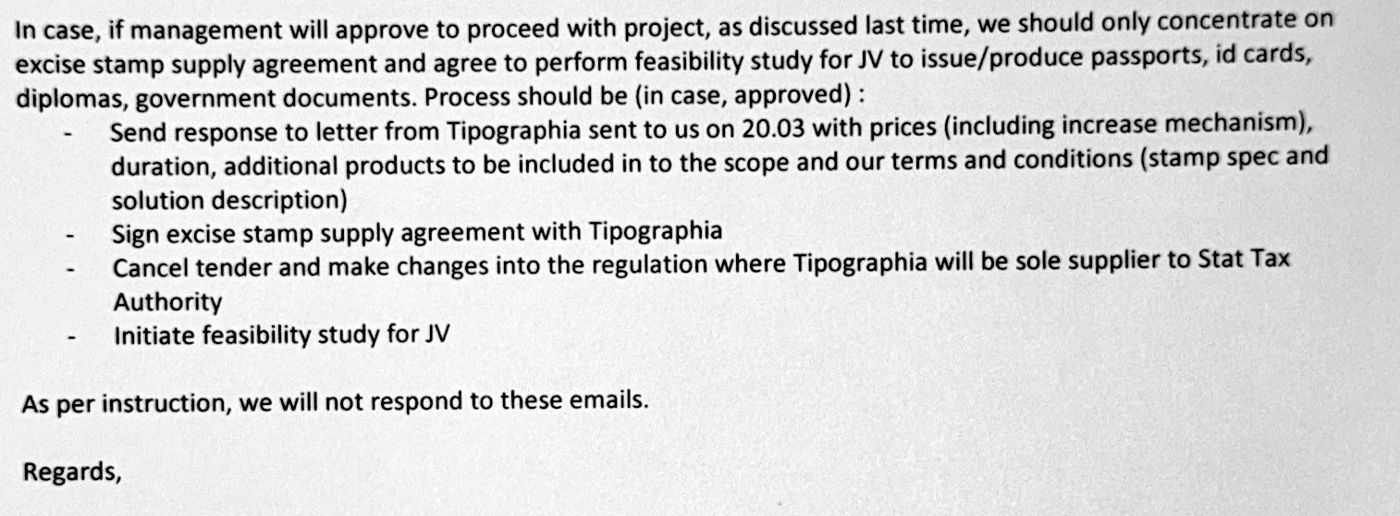
The intended chain was clear: classify tax stamps as secure government documents; place supply with the state printing enterprise, Tipographia; have Tipographia subcontract SICPA for five years; cancel the existing tender. These emails document a proposed arrangement. They do not, by themselves, prove that the necessary legal changes were adopted.
On 16 April, Erdenee set out a numbered roadmap. Its third item was explicit: “Cancel tender and make changes into the regulation where Tipographia will be sole supplier.”
 Open document at full size
A regulatory change in another country was being discussed as a step in a corporate business plan.
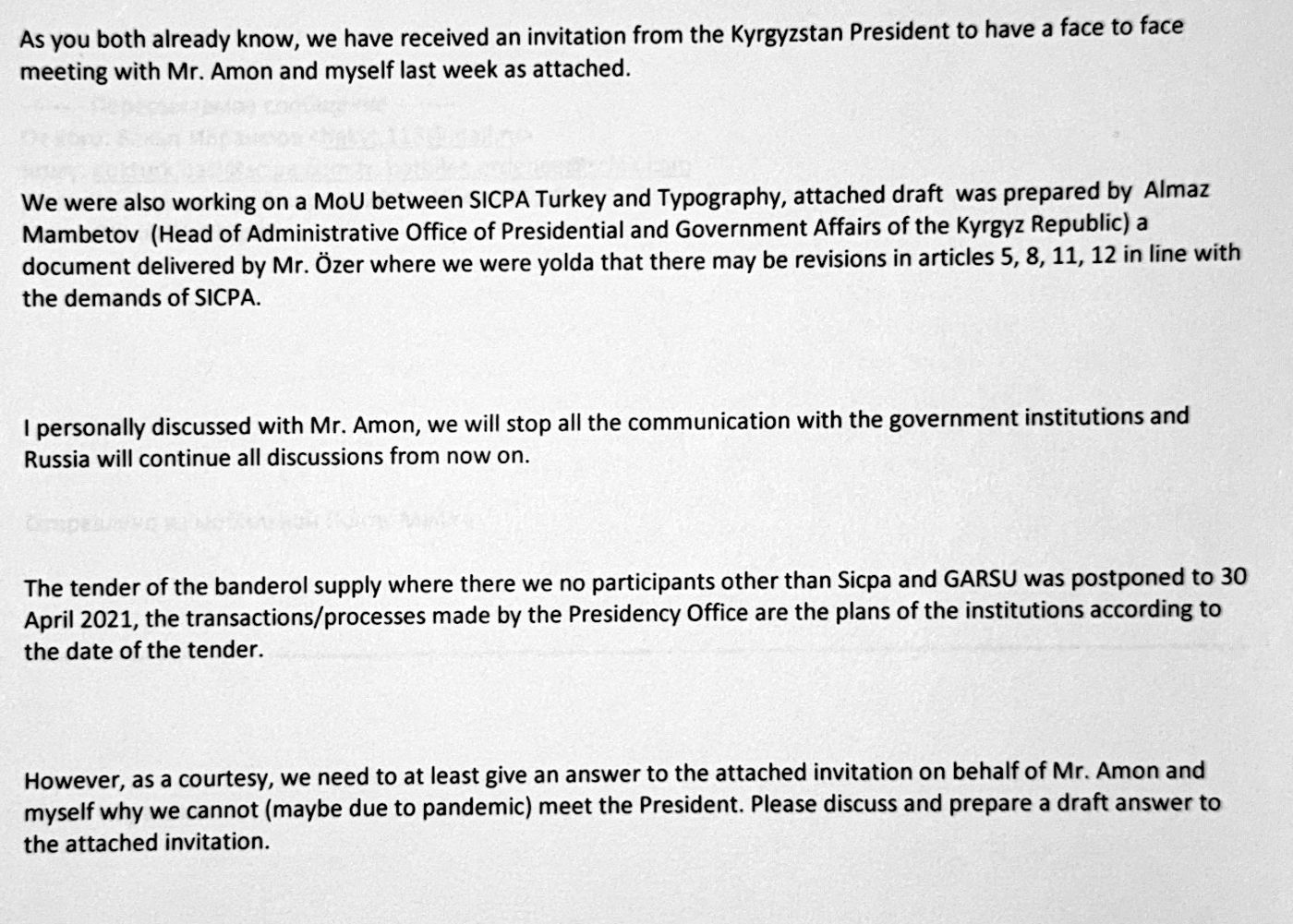
The file also contains a memorandum-of-understanding draft dated 7 April 2021. Under its terms, the state printer would not conclude an agreement with another private company for five years. SICPA Turkey would invest at least US$10 million and receive 80 per cent of profits during the first four years. SICPA Turkey’s general manager attributed preparation of the draft to Almaz Mambetov, head of the Kyrgyz presidential affairs administration. That attribution comes from the company’s correspondence.
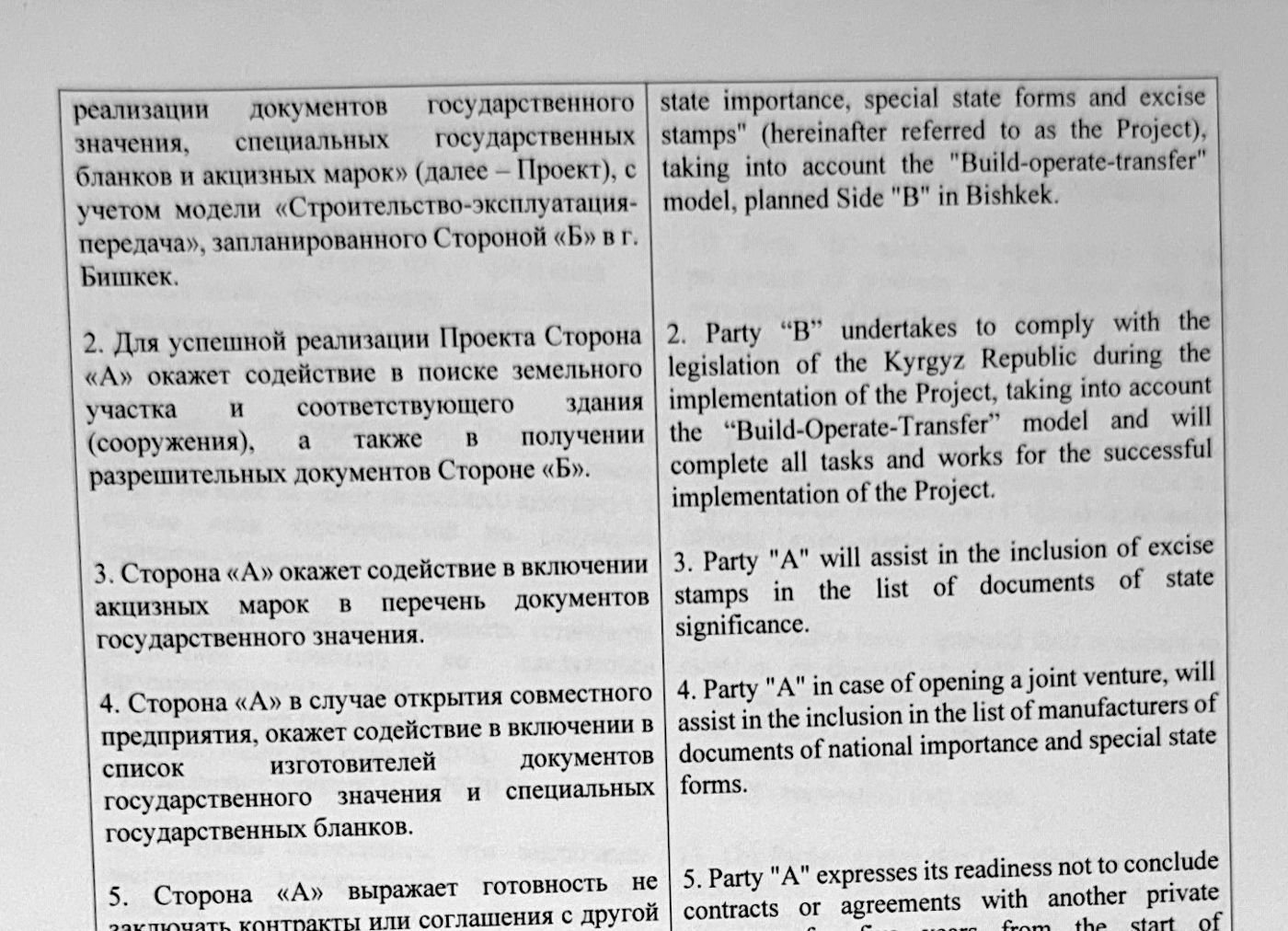 Open document at full size
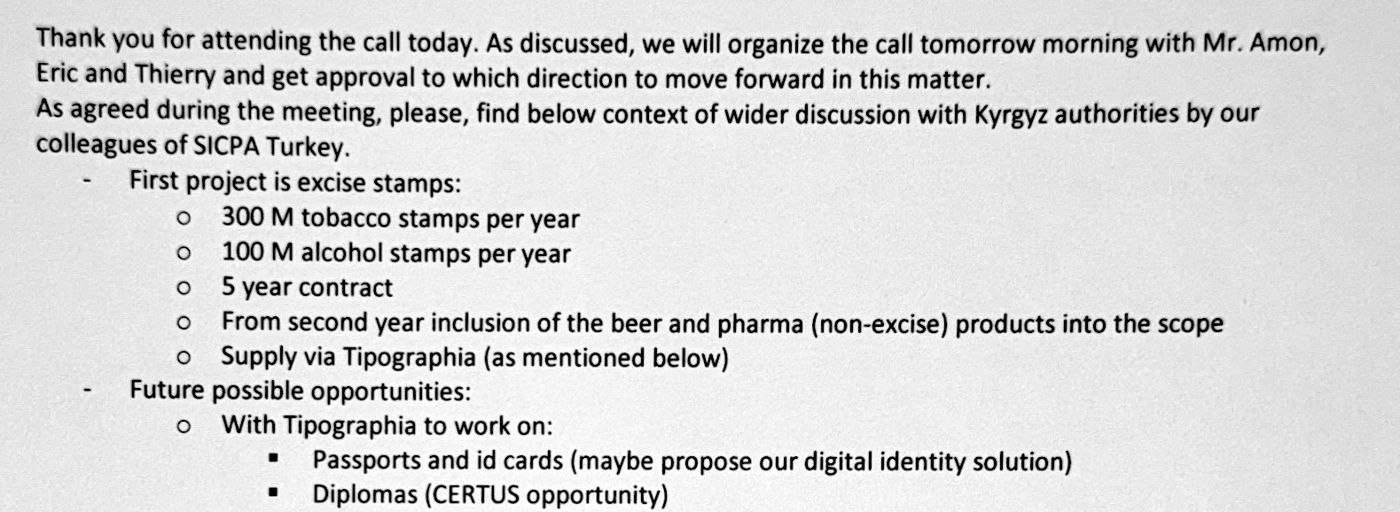
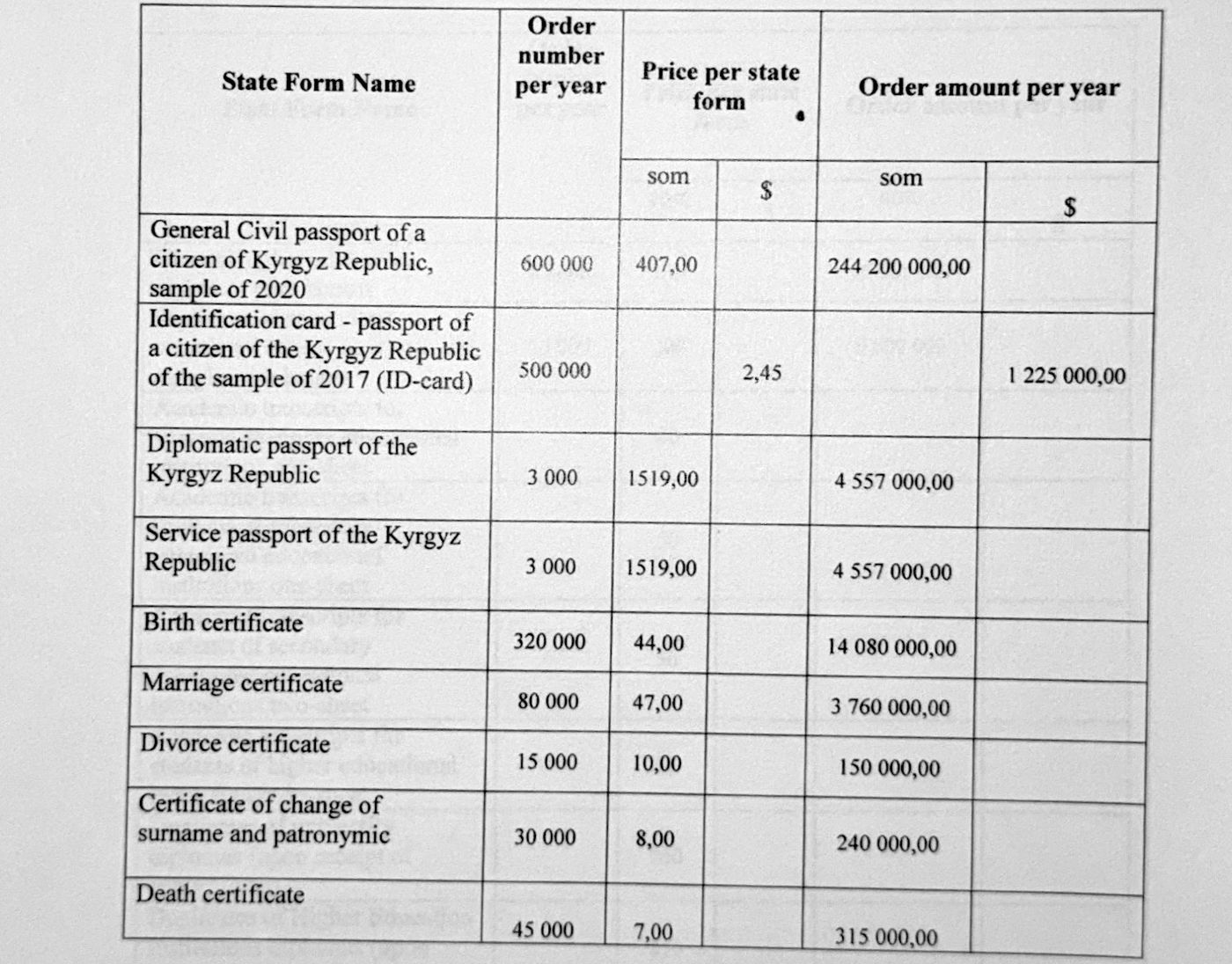
The ambition extended beyond stamps. Erdenee listed future opportunities involving passports, identity cards and diplomas. Tipographia had also supplied SICPA Turkey with quantities and prices for official documents, including 600,000 passports, 500,000 identity cards and 320,000 birth certificates.
 Open document at full size
 Open document at full size
An invitation from Bishkek, a change of course in Lausanne
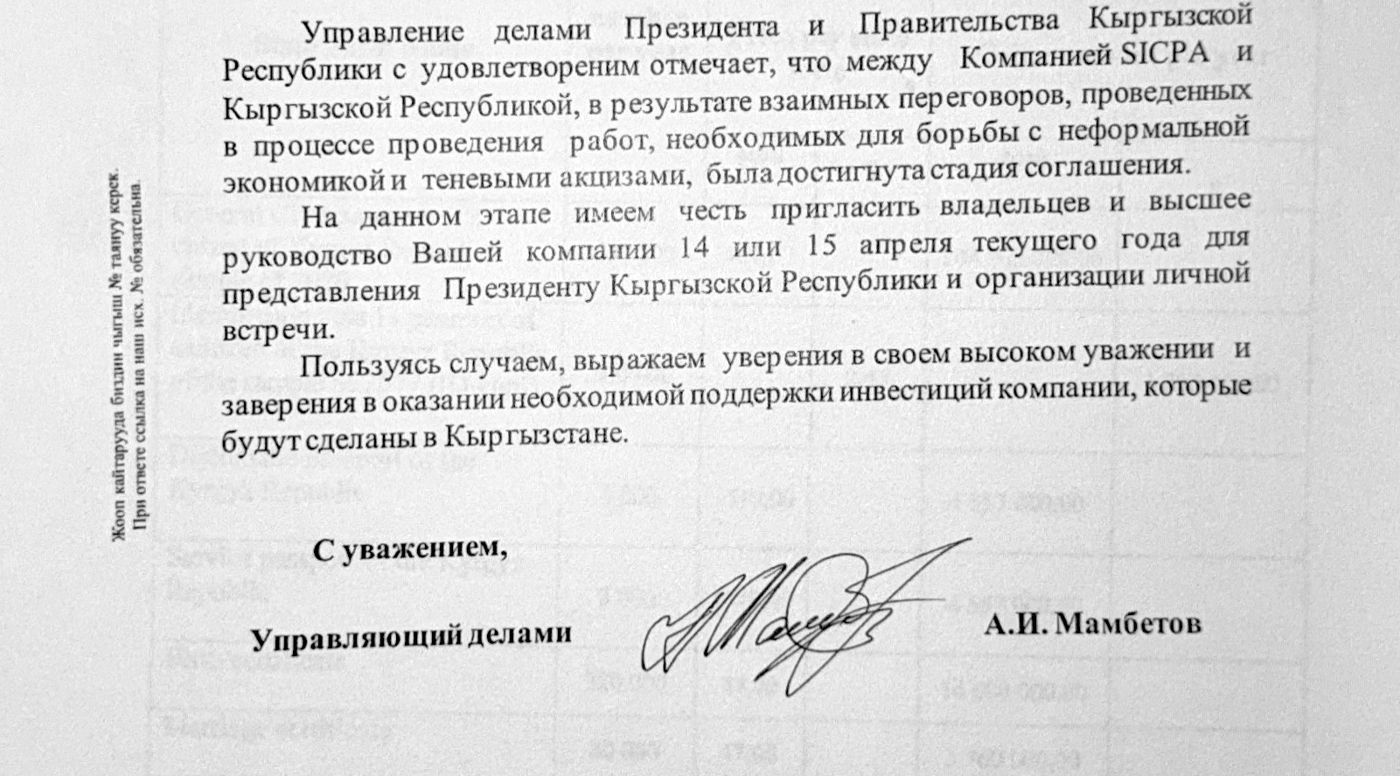
On 12 April 2021, an official letter left Bishkek. It bore reference 01/121 and Mambetov’s signature, and was addressed to Philippe Amon and SICPA Turkey’s general manager.
The letter welcomed progress towards an agreement between SICPA and the Kyrgyz Republic and invited the company’s owners and senior management to meet the president in person on 14 or 15 April.
 Open document at full size
The procurement process was still open, according to the company’s account. The general manager identified one competing bidder: Lithuania’s Garsų Pasaulis. The invitation therefore raises a question about access during an ongoing competition. It does not itself establish that improper preferential treatment occurred.
Amon did not take up the visit, according to the subsequent exchange. The next day, SICPA Turkey’s general manager told colleagues he had spoken with Amon and that the Turkish operation would stop contact with Kyrgyz government institutions: “Russia will continue all discussions from now on.” For explaining the missed visit to the president, he floated a parenthetical suggestion: “(maybe due to pandemic).”
 Open document at full size
The allegation of “inappropriate offers”
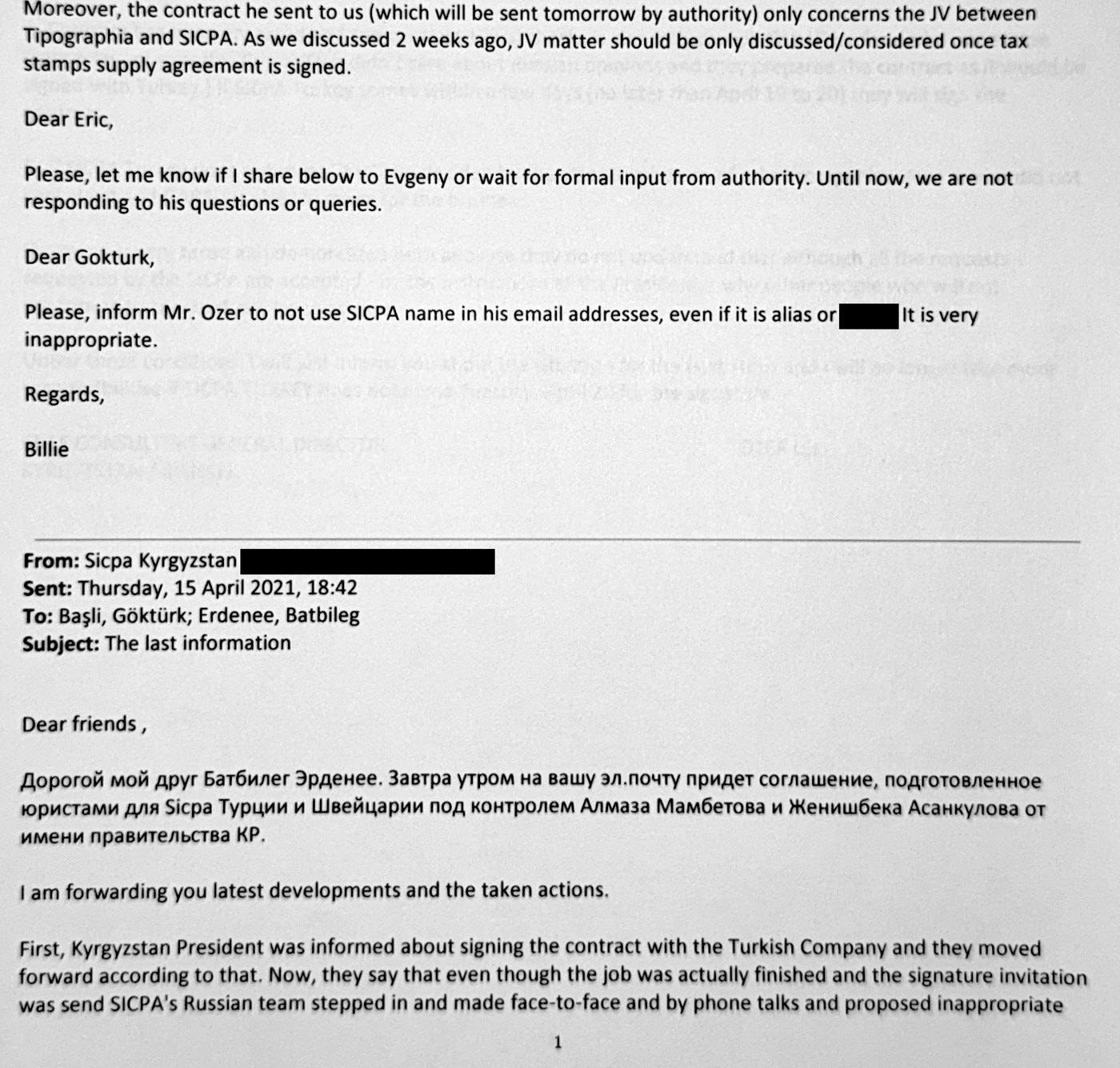
Özer Lel reacted sharply. On 15 April 2021, he emailed Lausanne and Istanbul. His signature identified him as general manager of ENES Consulting, while the Gmail account’s display name was “Sicpa Kyrgyzstan.”
Erdenee objected to that account presentation: “It is very inappropriate.” The visible reaction concerns the use of the SICPA name. It cannot establish the extent of any internal inquiry into the rest of Lel’s message.
Lel relayed what he said Kyrgyz counterparts had told him:
“SICPA’s Russian team stepped in and made face-to-face and by phone talks and proposed inappropriate offers to the people.”
 Open document at full size
Lel did not specify what those offers were. This is a consultant’s report of others’ statements, not proof of bribery, a payment or a particular unlawful proposal.
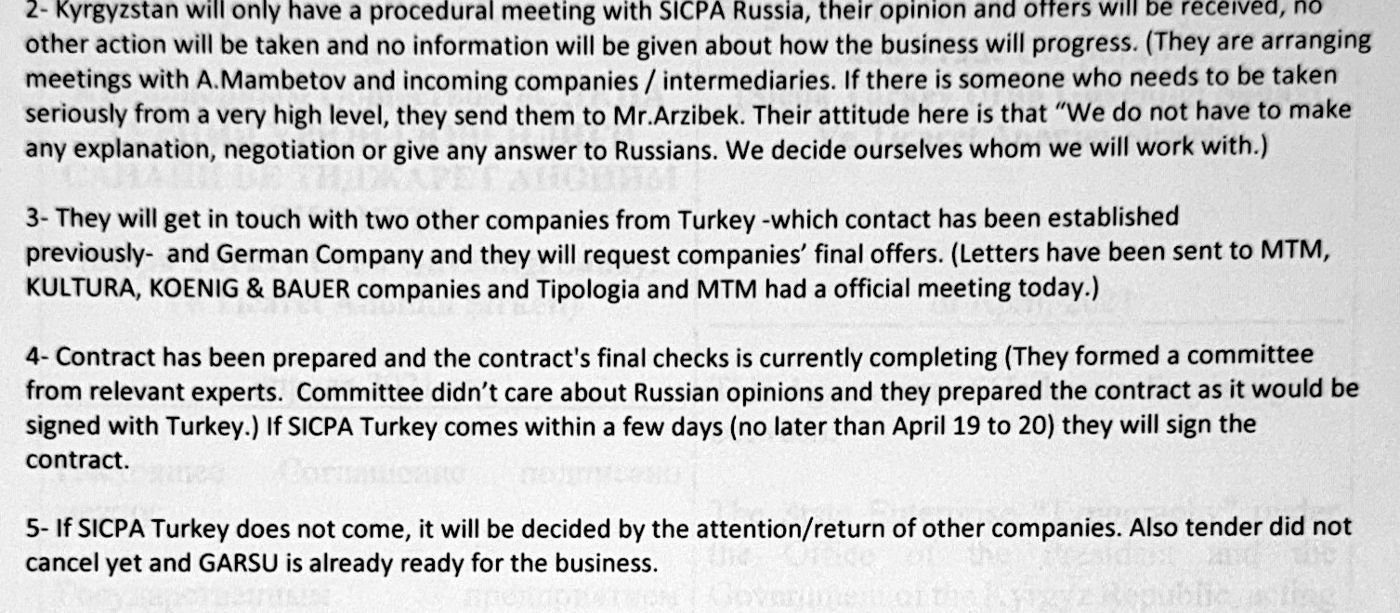
The same message attributed an angry response to Kyrgyz counterparts: were the Swiss trying to leave them as a plaything in Russian hands? If they had wanted to work with the Russians, the message said, they would not have endured five months of uncertainty. The continuation discusses formal-only engagement with the Russian team, letters to MTM, Kultura and Koenig & Bauer, and states that “GARSU is already ready.”
 Open document at full size
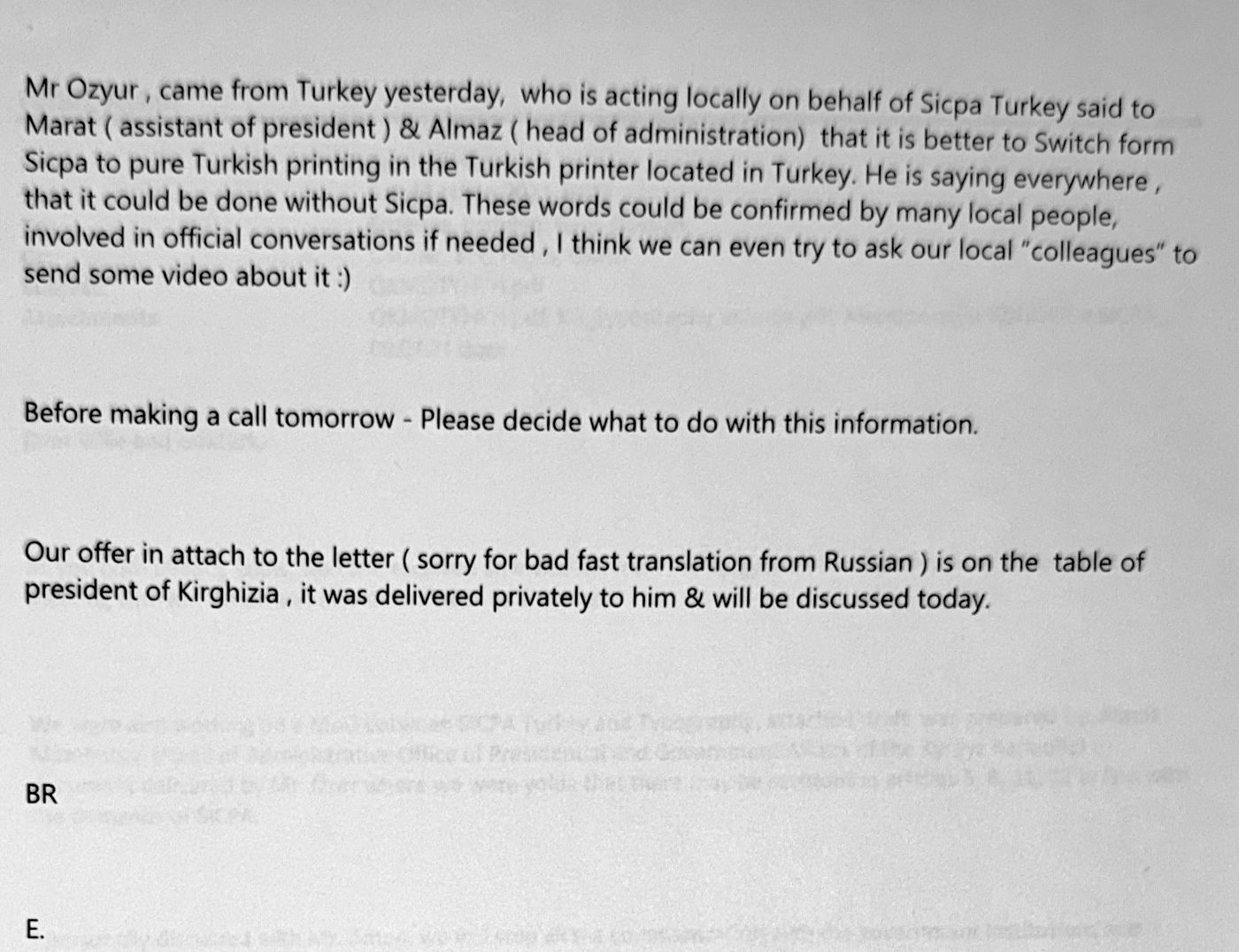
The Russian team pressed on. On 20 April, Matveev wrote from Bishkek directly to Amon. In challenging the local account, he suggested asking local “colleagues” to send a video, ending the remark with a smiley. He then described another route to the president:
“Our offer […] is on the table of president of Kirghizia, it was delivered privately to him.”
 Open document at full size
This is a company employee’s assertion that an offer reached the head of state outside the ordinary tender exchange. Whether that delivery occurred as described, and what procedural rules applied to it, remain questions for the parties and the authorities.
On 30 April, Erdenee wrote that SICPA Turkey’s general manager and a team had “managed to postpone tax stamp tender in KG until 20th of May.” Nine days earlier, the general manager had told Amon that contact with Kyrgyz counterparts had ceased. The two accounts leave an unresolved question about who remained involved and in what capacity.
Matveev’s reply on 30 April added a commitment concerning the Turkish side: “work done by Turkish colleagues & their partners will be remunerated as it was agreed preliminary.” Which partners, which preliminary agreement and what remuneration were meant are not established in the extracts.
 Open document at full size
The company SICPA suggested took the project
While the teams argued, Kyrgyz counterparts looked for other suppliers. SICPA Turkey itself helped identify them. On 21 April 2021, its general manager told Amon that the Kyrgyz side wanted an invitation-based process and that the names and contact details of MTM and Kultura had been supplied as alternative Turkish companies.
 Open document at full size
Neither name was unfamiliar to SICPA. Erdenee’s note described MTM as a hologram company in which SICPA Turkey held 17 per cent. The general manager called Kultura “our business partner.” According to those internal accounts, the suggested alternatives had existing business links with SICPA Turkey.
In the third week of April, a Kyrgyz delegation visited Istanbul. The correspondence identifies presidential adviser Marat Tursunbekov as its head and Özer Lel as a participant. SICPA Turkey’s Göktürk Başlı hosted an iftar meal. The delegation visited Kultura and the Turkish Mint.
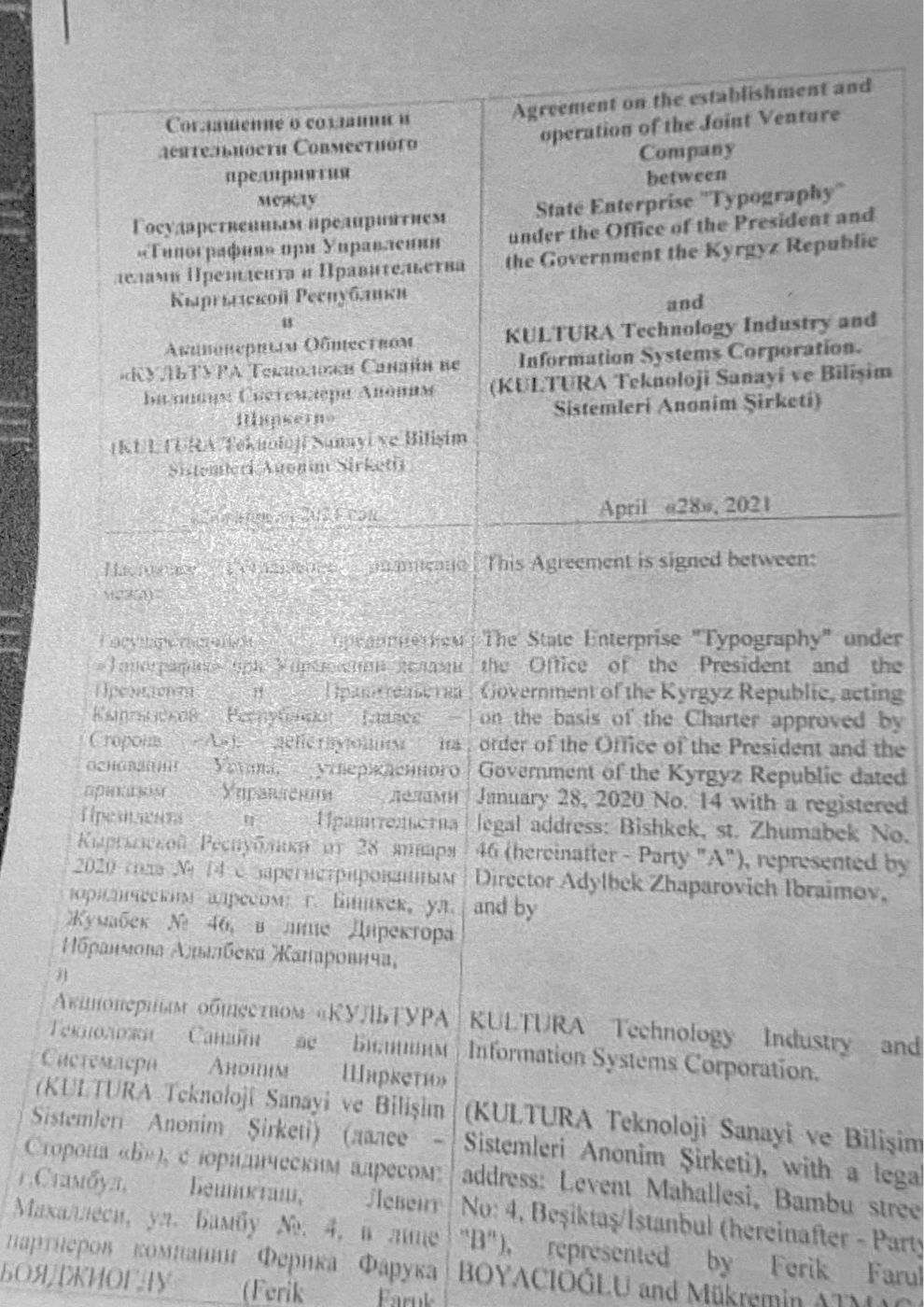
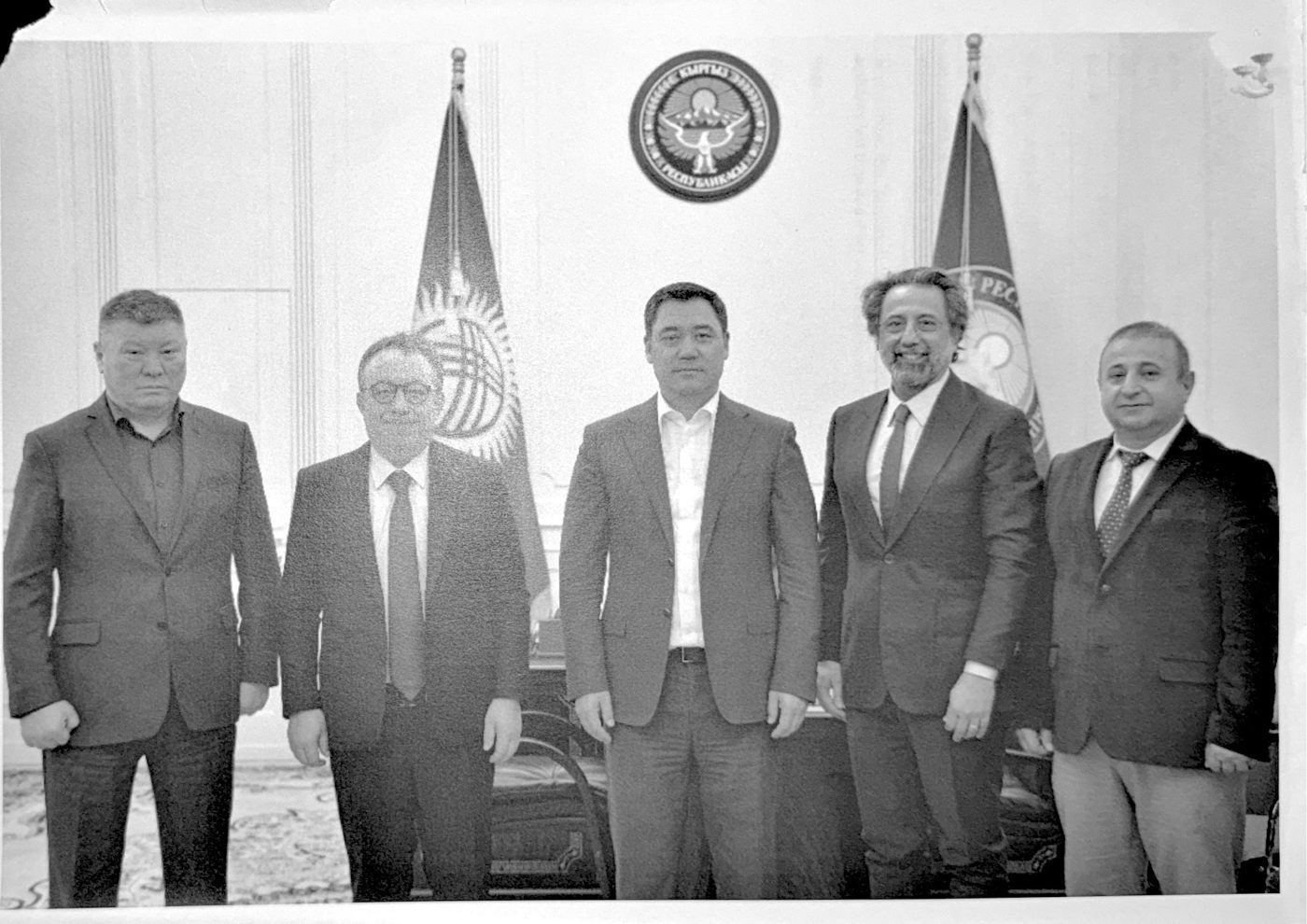
On 28 April 2021, Tipographia and Kultura Teknoloji Sanayi ve Bilişim Sistemleri A.Ş. signed a joint-venture agreement in Bishkek. The SICPA Turkey account identifies Kultura’s representatives as Ferik Faruk Boyacıoğlu and Mükremin. It describes a twenty-year arrangement encompassing passports, identity cards and tax stamps, and a warm reception by the president. The file includes the agreement’s opening page and a commemorative photograph.
 Open document at full size
 Open document at full size
The company SICPA Turkey had identified as a business partner obtained an agreement while SICPA’s own proposed arrangement had not materialised. Yet the correspondence suggests SICPA still considered a possible role.
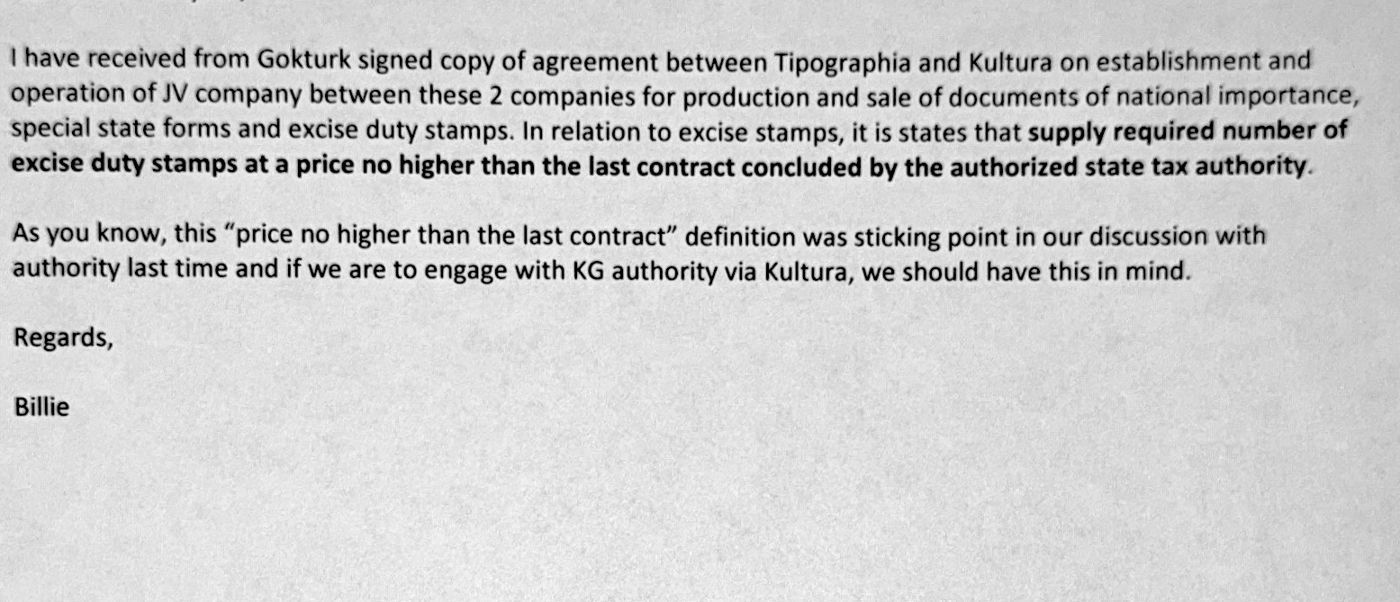
On 11 May, Erdenee wrote that he had received a signed copy of the Tipographia–Kultura agreement. He highlighted a condition: tax stamps were to be supplied at a price no higher than that of the last contract concluded by the authorised state tax authority. That ceiling had been a sticking point in SICPA’s earlier discussions. If SICPA were to engage with Kyrgyz authorities through Kultura, he wrote, the team should keep it in mind.
 Open document at full size
A year later, an invoice
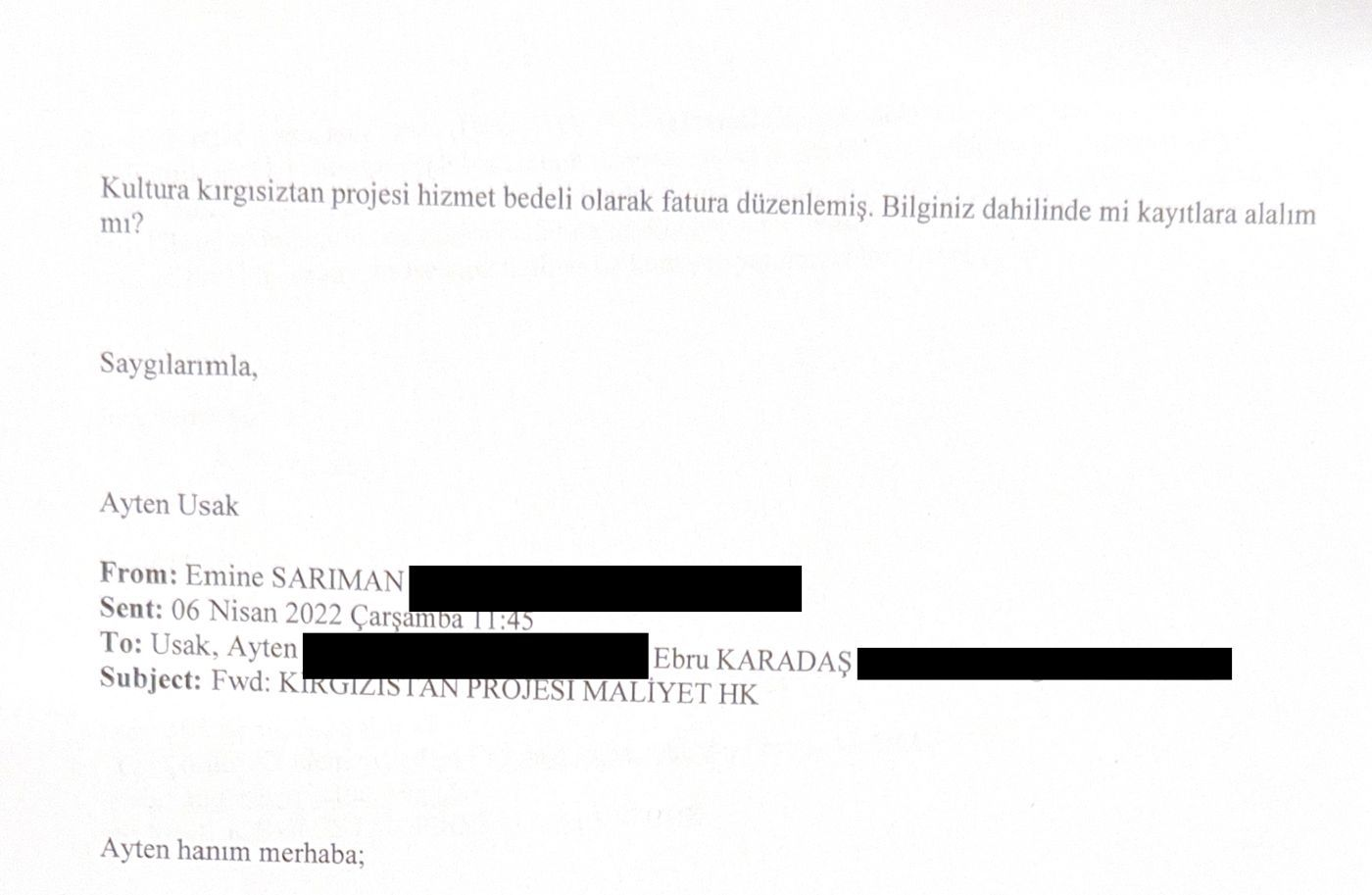
A second set of correspondence moves the story to April 2022. On 5 April, Kultura’s accounting team emailed SICPA Turkey under a subject referring to Kyrgyzstan project costs, with a cost schedule and an invoice attached.
SICPA Turkey’s accounting team described it the following day as an invoice issued by Kultura for “Kyrgyzstan project service fees.”
 Open document at full size
Why was the company that obtained the joint venture billing SICPA Turkey, whose proposed deal had not gone ahead? The correspondence supplies competing accounts, but not a settled answer.
On 11 April, SICPA Turkey’s former general manager wrote to Gianni Nigro in Lausanne. By then, he was no longer running the Turkish operation. He described having managed it for six years and signed a new contract with SICPA. His explanation for Kultura’s spending was direct:
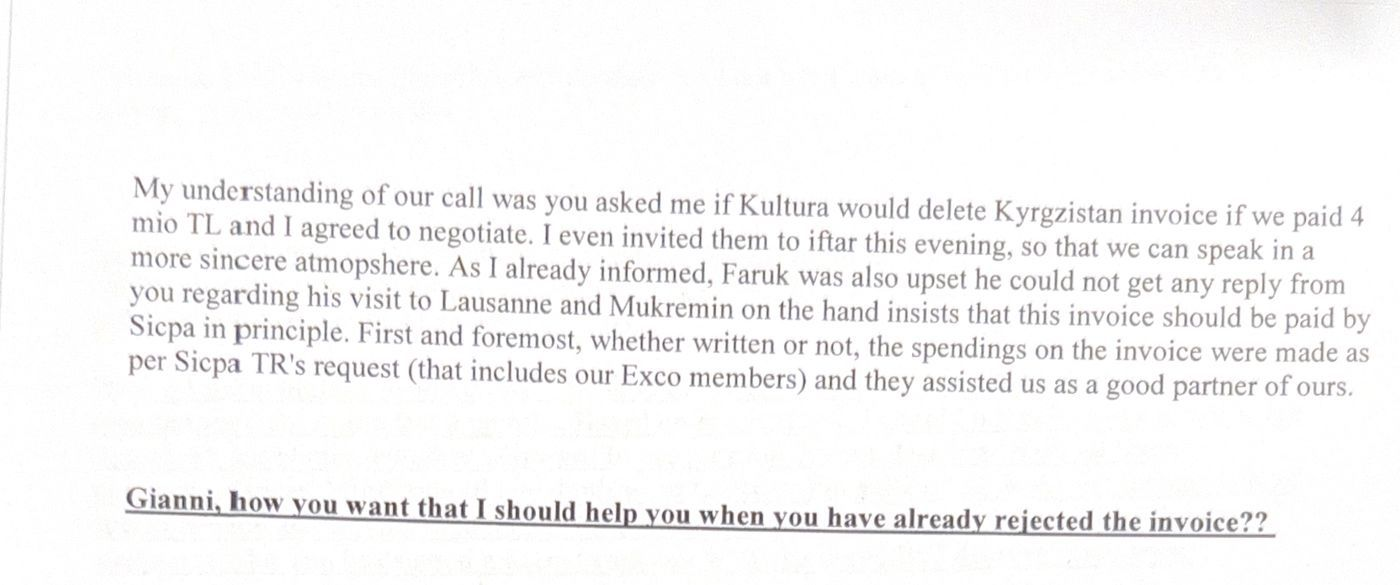
“First and foremost, whether written or not, the spendings on the invoice were made as per Sicpa TR’s request (that includes our Exco members) and they assisted us as a good partner of ours.”
This attributes the expenditure to requests from SICPA Turkey, including executive-committee members, while allowing that the instructions might not have been in writing. It is the former general manager’s account, not an independently audited statement of who authorised or received each expense.
A SICPA Turkey executive also recorded that the costs concerned the track-and-trace side of the business. According to that email, the former general manager had said SICPA SA’s senior management knew about the matter and the invoice could be issued. The executive added that Kultura had been requesting the money since December 2021.
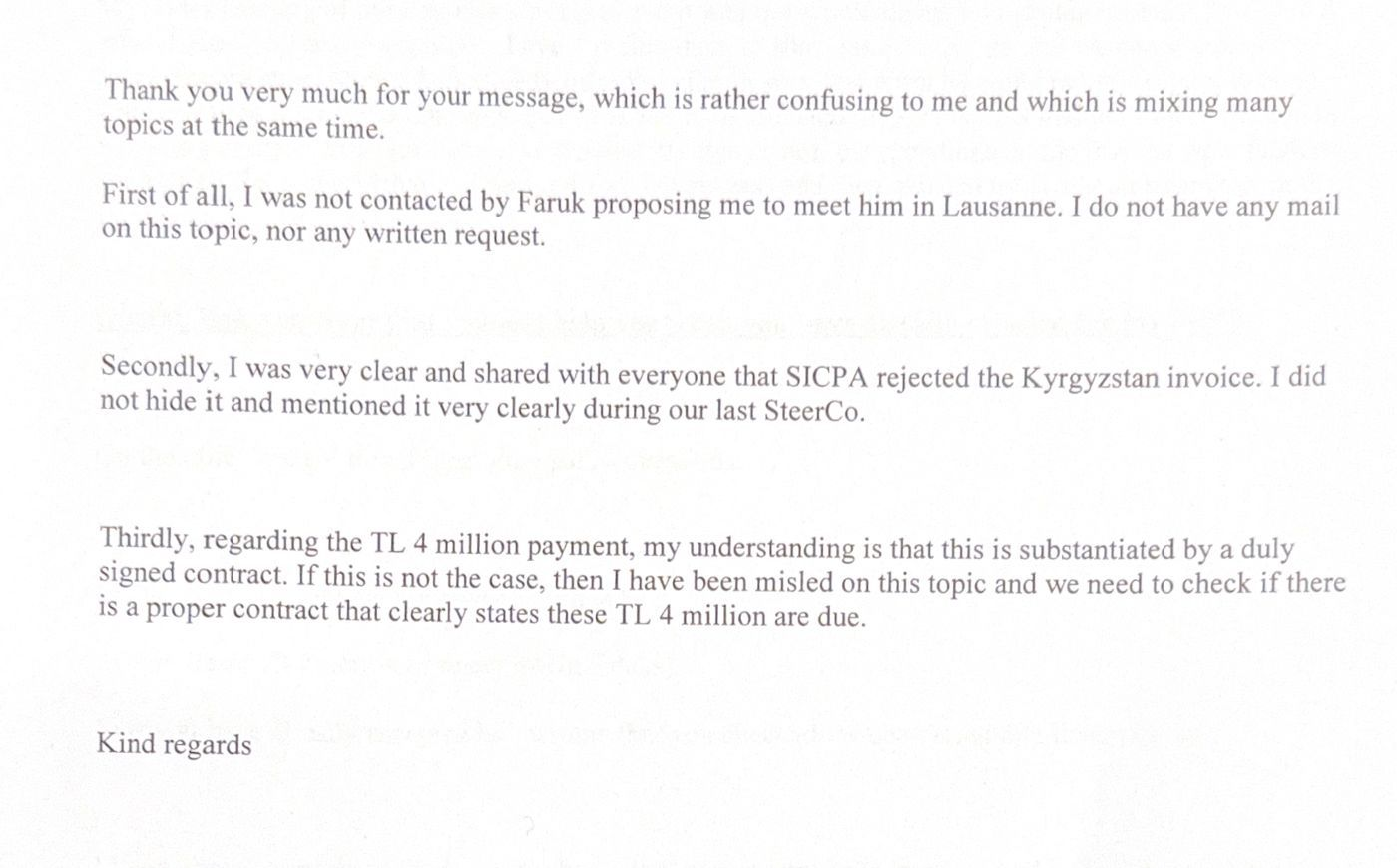
SICPA’s position was to reject the invoice.
 Open document at full size
Nigro wrote that SICPA had rejected the Kyrgyzstan invoice and that he had made this clear at the steering committee. His email also questioned the documentation for a separate TL4 million payment.
 Open document at full size
“If we paid 4 mio TL”
Rejecting the invoice did not end the discussion. The former general manager described a proposed negotiation arising from a telephone call with Nigro:
“My understanding of our call was you asked me if Kultura would delete Kyrgzistan invoice if we paid 4 mio TL and I agreed to negotiate.”
 Open document at full size
A SICPA Turkey executive’s account describes the same proposal: could the former general manager negotiate rejection of the Kyrgyzstan invoice if the TL4 million invoice were paid?
The correspondence treats the TL4 million as a separate item. It describes an agreement with Kultura dating from 2018, involving 17.5 per cent of net profit and a TL40 million guarantee spread over several years. The TL4 million was described as the 2022 advance under that arrangement.
The records do not justify calling that amount an undisputed, already-established debt. Nigro explicitly said he believed a duly signed contract supported it; if not, he had been misled and the company needed to check whether a proper contract made the amount payable. Nor do the emails establish that the Kyrgyzstan invoice was ultimately cancelled, deleted from accounting records or exchanged for a payment. They document a proposed negotiation and a dispute about its basis.
An iftar meal was arranged to discuss the issue in what the former general manager described as a more informal setting. It did not resolve the dispute. On 13 April, he reported that Faruk and Mükremin had rejected SICPA’s approach and demanded all payments immediately. According to his account, Mükremin insisted that SICPA should pay the Kyrgyzstan invoice “as a matter of principle.”
 Open document at full size
The copy line includes SICPA chief legal counsel Nicolas Narbel and group finance executive Jean-Marc Vanescote. This shows that those addresses were included in the correspondence. It does not prove that either person read every message, endorsed the proposals or took a particular action.
The former general manager also challenged the handling of earlier invoices. He alleged that previous management had accepted invoices totalling up to TL50 million on the basis of assertions alone, said he would take the matter to auditor E&Y, and wrote: “I leave it up to you on who is misleading who.” Those are allegations in a commercial dispute, not verified audit findings.
He further argued that the arrangements and payment practices had been established through decisions and involvement at SICPA SA level: management in Türkiye had changed, he said, while management at SICPA SA remained the same.
What this file establishes, and what remains open
The documentary sequence runs from an internally described tender revision to a proposed state-printer route, a change of company team, a partner’s joint venture and a later disputed service invoice. It warrants questions about procurement transparency, the role of intermediaries, corporate authorisation and the relationship between proposed payments. It does not establish that any public official received money, that the suggested regulatory route was unlawful or completed, or that the disputed invoice was ultimately paid or removed.
There is a separate, documented Swiss enforcement history. On 27 April 2023, Switzerland’s Office of the Attorney General imposed a CHF1 million fine and a CHF80 million compensatory claim on SICPA SA for corporate organisational failures connected with bribery of foreign public officials. The official account identifies Brazil, Colombia and Venezuela. It also records the discontinuance of proceedings against the CEO and major shareholder. That decision is not a ruling on this Kyrgyzstan file. Swiss OAG release; OAG 2023 annual report, p. 27.
The company disputed the grounds of that decision and said the organisational shortcomings had been remedied. An OAG side letter published by SICPA also states that the deficiencies relating to the 2008–2015 period were voluntarily remedied and distinguishes corporate organisational responsibility from the company itself committing or approving the underlying acts. That historical position must be kept separate from unanswered questions about the later Kyrgyzstan correspondence. SICPA’s 27 April 2023 statement; OAG side letter published by SICPA.
The Kyrgyzstan documents date from 2020–2022, when the earlier Swiss investigation was still pending. That overlap is a matter of chronology. It is not evidence that the Swiss findings extend to Kyrgyzstan or to every person named here.
The Ledgers’ wider SICPA reporting raises related questions about intermediaries, procurement design and oversight. Comparisons across files are editorial analysis; each allegation requires its own evidence.
The Ledgers asks
For Philippe Amon and SICPA SA
1. Was the Kyrgyz tender dated 12 November 2020 cancelled to enable SICPA to bid, as the executive note states? Who revised its specifications with Kyrgyz officials in Istanbul, and under what authority? 2. Was the 6 April 2021 proposal to classify tax stamps as government documents and cancel the tender transmitted to the Russian team on Amon’s instructions? What was authorised? 3. What were the “inappropriate offers” alleged in Lel’s account? Did SICPA investigate that allegation, and with what result? 4. Was the offer delivered privately to the Kyrgyz president as Matveev claimed? Who delivered it, and why was that route used? 5. What, if anything, was paid to Özer Lel or ENES Consulting? Which partners were covered by the preliminary remuneration arrangement mentioned on 30 April? 6. What expenses did Kultura incur for SICPA’s Kyrgyzstan work, who received the funds and which executive-committee members, if any, requested the spending? 7. Who authorised the proposal linking a TL4 million payment to withdrawal of the Kyrgyzstan invoice? What review, if any, was undertaken by legal or finance staff copied into the exchange? 8. Was the Kyrgyzstan invoice eventually paid, cancelled, settled under another description or left outstanding?
For Kultura
1. What was the amount of the Kyrgyzstan project service-fee invoice issued to SICPA Turkey, and what items appeared in its cost schedule? 2. What became of the twenty-year joint venture signed in Bishkek? 3. In which activities did Kultura act on its own behalf, and in which, if any, did it act for SICPA?
For SICPA Turkey’s former general manager
1. What expenditure was covered by the phrase “whether written or not,” to whom was it paid and what instructions supported it? 2. Who comprised the team said to have secured postponement of the tender to 20 May, and whom did it approach?
For the authorities in Bishkek
1. Why did the presidential affairs administration invite a participating company to meet the president through letter 01/121 while the tender process was still open? What procurement and equal-treatment safeguards applied?
Editorial note
This report is based on the internal correspondence, draft agreements, copies of official letters and photograph reproduced in the supplied dossier. The 23 illustrations preserve the document extracts’ scope; they are not presented as complete email archives or complete contracts. Private contact details already redacted in the exhibits remain redacted. The cover is an AI-generated editorial illustration, not a photograph documenting the events.
The documents do not show payment to a public official. “Inappropriate offers” is a consultant’s second-hand allegation whose substance is not specified. Drafts, proposals, copy lines and disputed statements have been identified as such. Everyone named is entitled to the presumption of innocence.
The questions above are published for response. The material supplied to The Ledgers does not contain responses to them or establish that they were sent on a particular date. This report therefore makes no claim that contact occurred or that any party declined to answer. Substantive responses and verifiable corrections can be incorporated into the reporting.
Source documents
02File updates
Report published
Editorial note
The publications used in this account are listed above.
Submit a response or correctionReader comments
Verified members can comment. Comments appear after editorial approval. Please address the evidence and avoid personal information.
No published comments yet.
Sign in / Create account →Stay with the story.
Follow The Ledgers for new investigations, developments in our case files and videos.
Choose The Ledgers in Google’s source preferences. Availability is determined by Google.