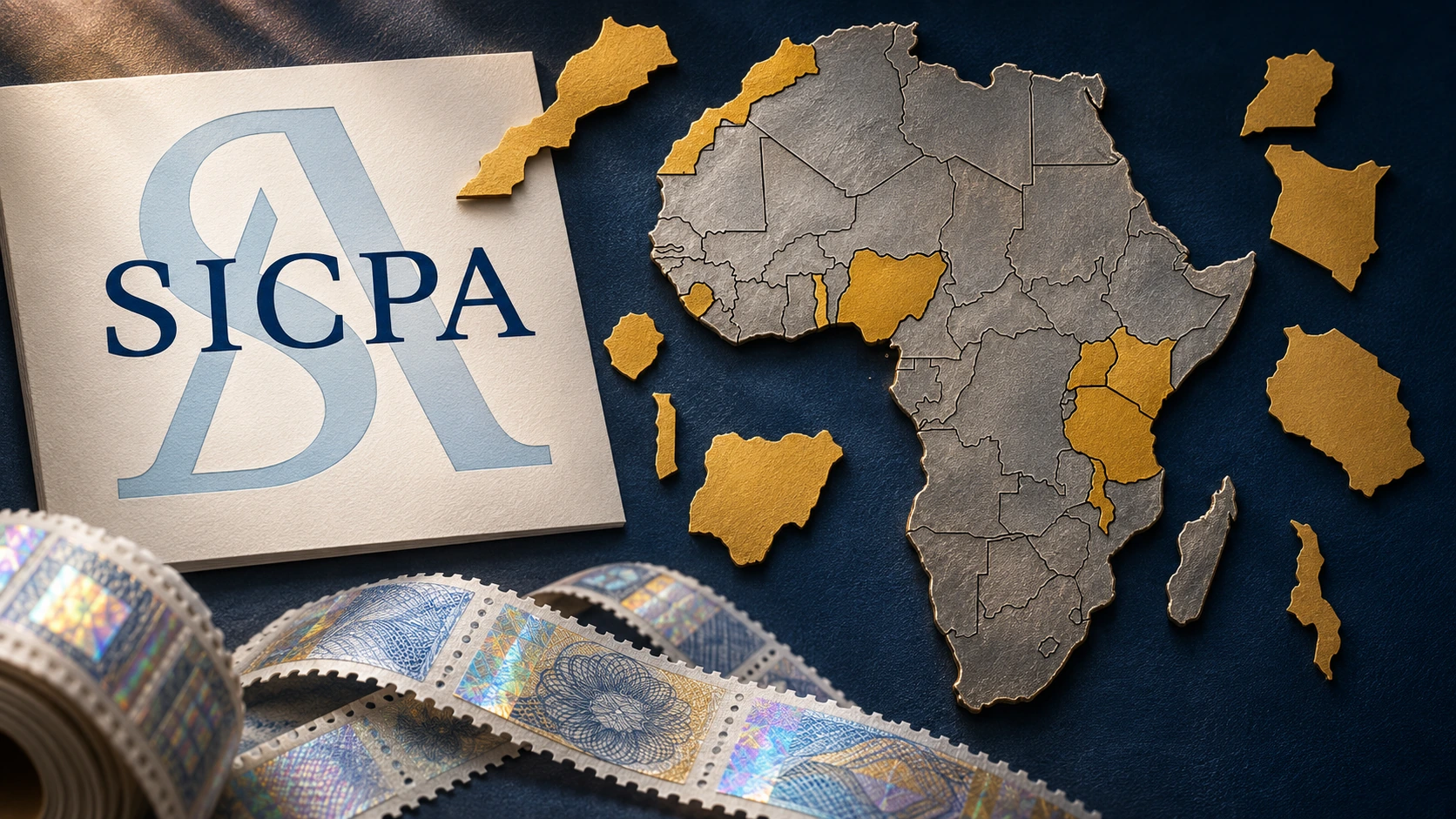
A map of the investigation
| Country | What the file contains |
|---|---|
| Kenya | Expansion without competitive tendering, high prices, debt and technological dependence |
| Uganda | A direct contract, payment despite Parliament's objections, allocation of public land |
| Tanzania | Tender disputes, high prices and the cancellation of a tender in 2023 |
| Togo | Political consultancy, tax exemptions and an opaque contract |
| Morocco | A 35–50% reduction in tax-stamp prices following competition |
| Malawi | A presidential meeting and objections to tender prices |
| Nigeria | Ministerial approval and a rival company's calls for an investigation |
| Sierra Leone | Problems with independent access to tax data |
From the hut tax to the bottle stamp
Open a Tusker in Nairobi. Just below the cap, on the edge of the label, is a stamp the size of a fingertip; it bears the name of the Kenya Revenue Authority and contains Prilly's ink. That stamp cost 1.50 shillings per bottle; in 2023, there was an attempt to raise it to 3 shillings. In Kampala, the stamp around the neck of a Nile Special costs 36 shillings, the one on a bottle of water 13, and the one on a cola 17. In Dar es Salaam, the stamp bill for a crate of cola is 194 shillings. In Lomé, the price of a beer stamp was set in euros and is paid in CFA francs. In Dar es Salaam it is called “stempu”, in Lilongwe “Kalondola”, in Lomé “SAM”; the name changes, the stamp does not, and the company never does.
In 1898, the British colonial administration in Sierra Leone imposed an annual tax of five to ten shillings on every home. London set the tax, the governor collected it, and the villager paid. The people rose up; history recorded it as the Hut Tax War.
In October 2026, Sierra Leone's National Revenue Authority sat down with SICPA executives on the sidelines of the IMF–World Bank meetings in Bangkok and made a request: access to its own tax data. A state was asking a Swiss company for the records of taxes collected from its own people on its own territory; it wanted to measure the company's performance independently of the company's own reports, to see what it was getting before expanding the contract. One hundred and twenty-eight years had passed; the bottle had replaced the hut, and the company had replaced the governor.
Some will find the word colony too strong. We found it too mild. The essence of colonial rule is not cannon and rifle; it is someone based outside a country collecting that country's revenue, striking a deal with the local authorities to do so, and sending the bill to that country's people. The consumer pays, the palace opens the door, and no one demands an accounting.
SICPA began as an ink company; today, it supplies the colour for most of the world's banknotes. But what it sells in Africa is not ink, but a concession: the right to affix a stamp to every product on which the state levies excise duty, to charge for every stamp, and to remain the sole company that builds the system. In the nineteenth century, “chartered companies” did this work: the Imperial British East Africa Company collected customs duties in Uganda and Kenya, while the Royal Niger Company levied taxes in the Niger Delta. The chartered company of the twenty-first century comes from Prilly, carrying an ultraviolet lamp instead of a rifle.
In this article, we are not alleging that SICPA paid bribes in Africa; there is no African court judgment saying that it did. What we are offering is a description of an arrangement based on public records and documents in our possession: prices, letters, tenders, debts, exemptions and a Swiss conviction. Most of the sources are at the end of the text.
The price of the stamp: who pays
To understand what the stamp costs, a bottle of fruit juice in Kenya is enough. In the first days of 2023, the Kenya Revenue Authority sought to increase stamp charges: from 2.80 to 5 shillings for a packet of cigarettes, from 1.50 to 3 for beer, from 0.60 to 2.20 for fruit juice, and from 0.60 to 2.50 for cosmetics. The authority gave its own reason for the increase: to cover the cost of the stamps and repay its 4.5 billion-shilling debt to SICPA. The price of a Kenyan's bottle would rise to settle a debt to Lausanne. The Law Society of Kenya went to court; in May 2023, the High Court halted the increase, and in November the Court of Appeal declined to overturn that decision; the case concluded in October 2026 without a ruling on the merits, on the grounds that it had been filed prematurely. Manufacturers had one message at the time: Kenya was paying more than Uganda and Tanzania for the same stamp from the same supplier. Retailers went further: the world's most expensive tax stamp. Put the figures side by side and it was no exaggeration; a thousand stamps cost 36 shillings in Sweden, 95 in the United Kingdom and 625 in Türkiye, but between 1,500 and 2,800 shillings in Kenya. By our calculation, dividing the number of stamps in the 2015 contract by the population yields nearly fifty Swiss stamps a year for every Kenyan, from babies to the elderly.
The contract behind the stamp followed the same path. The first contract, signed in December 2012, was worth €20.3 million over five years; in 2015 its scope was expanded without a competitive tender, and the figure rose to €158.2 million, or 17.8 billion shillings at the exchange rate of the day. In 2016, the procurement oversight authority told Parliament that the contract rested on “forged documents”; Business Daily ran the headline: “KRA deal with Swiss company is fraudulent.” The six-year legal battle ended in October 2023 with a Court of Appeal ruling in KRA's favour. SICPA welcomed the decision and, in the same week, drew attention to the 4.5 billion shillings it was owed.
That debt is the strangest part of this arrangement. A system built to collect taxes left the tax authority in debt to the company that built it: €31 million in June 2023, or 4.8 billion shillings at the prevailing exchange rate; 3.62 billion shillings in June 2024. According to KRA's own explanation, this was because the fees charged for stamps on non-alcoholic drinks were below the cost paid to SICPA, and because the shilling had weakened against the euro. The stamp's price was set in euros, while its fee was collected in shillings; Kenya bore the exchange-rate difference and was only able to switch payment to shillings in 2024. In August 2024, the debt “necessitated” another one-year extension of the contract without a competitive tender. You cannot replace a supplier who is your creditor. First debt, then dependence.
In Uganda, the story is shorter, because there was never a tender. In 2019, the stamp charge was set at 55 shillings for a bottle of beer, 110 for a packet of cigarettes and 240 for a bottle of whisky; the government picked up the bill in the first year. Parliament's Budget Committee had rejected the funding request in May 2019; MPs called the request “fraud” and moved for the head of the Revenue Authority to be dismissed. The Finance Ministry paid anyway: 60.8 billion shillings, in the words of committee chair Amos Lugoloobi, “a slap in the face of Parliament”. Parliament heard that the contract would reach 129 billion shillings once fully implemented. Manufacturers calculated their own bill at 100 billion shillings a year; Nile Breweries spent 30 billion on machinery alone. A report commissioned from PwC by the Private Sector Foundation in May 2024 found that stamps in Uganda were, on average, 28.7% more expensive than in Kenya and 25.9% more expensive than in Tanzania: a “compliance cost” of 16 shillings for every 100 shillings of excise duty. A remark made in 2020 by the foundation's former executive director, Gideon Badagawa, reads like a summary of this file: “All that money spent on a Swiss company should have stayed in this country.”
In Tanzania, Parliament did the arithmetic. In June 2018, Budget Committee chair Hawa Ghasia set out the company's investment at $21.5 million, or 48.5 billion shillings, against the 66.69 billion shillings to be collected from consumers every year; by the committee's calculation, this meant an additional 22.73 shillings on a half-litre beer, 13.5 on a soft drink and 29.57 on a bottle of spirits. Ghasia said: “That is too much for a company that has invested only 48.5 billion.” In the same sitting, Ilala MP Mussa Azzan Zungu had already captured the thesis of this investigation in a single sentence, years before: “We are handing our tax system over to a foreign company.” In 2020, cigarette manufacturer TCC said that it was paying SICPA $20 for a thousand stamps, compared with the $4.77 it had paid previously, a cost increase of 319%. In 2022, the Confederation of Tanzania Industries, CTI, called for a 75% reduction; its president, Leodegar Tenga, gave a simple reason: “The money collected goes to the foreign company doing the work; the state gains nothing.” By Daily News's rough calculation, SICPA collected about 100 billion shillings a year between 2018 and 2021. The Revenue Authority cut the fees by 8% in 2022 and reduced them again in 2024. The fact that a fee can be cut twice shows how high it was set in the first place.
In Togo, prices were set in euros and paid in CFA francs; that is what two ministerial decrees from 2019 say. The contract itself has never been published; the Paris-based La Lettre du Continent described a deal worth “several billion CFA francs”, and the Togolese Consumers' Association asked for the contract to be disclosed, without success. The government says the system generated 35.8 billion CFA francs for the state between 2020 and 2025 and that more than two billion products were stamped; it does not disclose SICPA's share. Field inspections in November 2025 and January 2026 found that 60–70% of the products examined had no stamps. That is the picture after five years and two billion stamps.
Morocco was the model's showcase, and Morocco demonstrated just how flexible the price was. SICPA won the work from Moroccan customs in 2010: 0.50 dirhams per packet of cigarettes, 0.20 per bottle of beer and 2.40 per bottle of whisky. Brasseries du Maroc, which controlled 97% of the country's beer market, refused to pay; SICPA stopped printing stamps, the factories stopped, and the brewer sued the state and SICPA. It lost. The tender was renewed in 2019; when Britain's De La Rue submitted a lower bid, accusations of “dumping” followed; SICPA retained the work by reducing its tobacco prices by 50% and its beer prices by 35%. Fifty per cent. When a price halves the moment competition sits down at the table, it tells you who is paying extra everywhere competition is absent. In Telquel's words in 2022, “some fifteen African countries followed Rabat's lead”; Casablanca is now SICPA's African hub.
The palace door: the price of a meeting
In SICPA's Africa, the road to a contract does not run through the tender table; it runs through the palace. That is what the documents show, and the route even has a price list.
The first Africa document published by The Ledgers on 26 October was a consultancy agreement. Dated 1 December 2019, the agreement had a public-relations company in Istanbul's Levent district on one side and Veritas Communications on the other, a company registered in the British Virgin Islands with a post-office box in Dubai as its address for service. The territory: Uganda, Somalia, Kenya, Tanzania. The clients were defined as “institutions and sovereigns”. The fee: $210,000 on 31 December and $210,000 on 15 January for “mobilisation”; a $400,000 service fee, payable upfront and non-refundable; then 12% of the net revenue generated for five years, rising to 15% thereafter. Invoices were issued: $420,000 on 15 December 2019 and $400,000 on 1 January 2020; the beneficiary account was at a bank in Tortola.
Clause three of the agreement explains how this business is measured. The consultant has six months of exclusivity; but if “a face-to-face meeting at presidential or senior ministerial level” takes place, exclusivity is extended by another six months. The deliverable is not a report, a feasibility study or a market analysis; it is an appointment. Under the agreement, eight hundred and twenty thousand dollars buys the opening of a palace door.
SICPA is not named in the document. We wrote that on the first day, and we write it again. But three things stand side by side. The agreement was signed on 1 December 2019; the Turkish tax-stamp tender that SICPA had held for years was cancelled on 6 December 2019. Three of the agreement's four countries—Uganda, Kenya and Tanzania—have tax-stamp contracts with SICPA. And the method is an offshore intermediary, an upfront fee and a percentage of a public contract. The source who supplied the file says the money was used for a tender under consideration in Uganda at the time; the source does not identify which tender. Uganda's stamp contract had been signed a year earlier. The parties did not respond to our first report; for this file, we are sending our questions to SICPA again. [Right of reply: dispatch and response status will be updated before publication.]
Behind Veritas's door are two partners; we wrote about both on 30 October. Alykhan Hudani is a prominent Kampala businessman: owner of the farm in Semuto that President Yoweri Museveni personally inaugurated in 2014, and, since 2025, Sierra Leone's honorary consul in Uganda. His partner, Abubaker Mukasa Muyunga, signed a telecommunications concession agreement with the Burundian state in 2008 and was a founding shareholder in Orange Uganda through his company Veritas. These are the people a company contracted and obtained invoices from to open doors: the man whose farm ribbon was cut by the president, and the man who signs concessions with states.
In Kenya, a letter opened the door. On 9 November 2021, the Energy and Petroleum Regulatory Authority, EPRA, launched a fuel-marking tender; Intertek led with a score of 91.1%, offering about 546 million shillings. On 6 December 2021, Interior Principal Secretary Karanja Kibicho wrote to EPRA director-general Daniel Kiptoo: a working group had selected SICPA; cancellation of the tender should be considered, and the work should be undertaken with SICPA, the Kenya Revenue Authority's tax-stamp supplier. The tender was cancelled on 28 December. In May 2022, the Treasury authorised “specially permitted procurement”; only one bid was submitted, and SICPA was awarded the work for about 2.35 billion shillings. More than four times the bid in the original tender. The Auditor-General subsequently identified 1.66 billion shillings in unbudgeted additional costs; the audit said the grounds for cancellation had not been reported to the procurement regulator and that an IT component added later had not been installed. Kibicho said his letter reflected a policy of integrating government systems, not a preference for a company. Perhaps. But the name of the policy and the name of the company appeared in the same letter.
In Uganda, the door opened in 2018, and the tender table was never set. The Uganda Revenue Authority awarded its digital tax-stamp system to SICPA through “single-source” procurement; the contract is dated 4 October 2018. Parliament refused the money; Finance paid. We have described that above. The real story lies in the land. According to New Vision's reporting in 2019, President Museveni instructed the Minister of Water and Environment to issue a “no-objection” letter for SICPA on the basis of a cabinet decision dated 28 January 2019: four acres, roughly sixteen Turkish dönüms, of land at the National Forestry Authority's headquarters in Kampala's Bugolobi district were to be leased to SICPA SA for a “digital stamp centre”. The reason given was that the company needed to be close to the Revenue Authority's headquarters. Interministerial correspondence, surveying teams and permanent-secretary memoranda followed. A Ugandan company sued the state, saying the forest land had not been formally declassified by Parliament; the outcome of the case has not been made public; the company's Uganda branch is now in Ntinda, not Bugolobi, and the land's fate is unclear. A cabinet decision, a presidential instruction, forest land: for a stamp company.
In Togo, the door had opened in 2009; according to the French press, a world-famous figure stood behind the expansion in 2016. In March 2017, the Paris-based La Lettre du Continent reported that Dominique Strauss-Kahn had first knocked on Benin's door for SICPA and, when that failed, turned to Togo, where he was “in direct contact with Faure Gnassingbé”. In April 2017, La Tribune Afrique continued the story in an investigation also reported by the Togolese press: “SICPA's African offensive relies heavily on DSK's network”; the former IMF chief had also been a financial adviser to the Togolese regime since 2016, and, “strangely”, fifteen days before the adoption of the 2017 budget law making stamps mandatory, the Togolese government had signed a direct contract with SICPA without a competitive tender. Challenges magazine supplied the figure in May 2018, reported in turn by Leral and Le360: Strauss-Kahn had been sitting on SICPA's strategy committees for three years and was receiving €80,000 a month; the company's owner had hired him and former EDF chief Henri Proglio to open Russia's doors. A company insider interviewed by the magazine described the dual consultancy this way: “He says he is going to Togo for SICPA, and then we discover that he is working for the government.”
A Finance Ministry decree in the 4 May 2018 edition of Togo's Official Gazette states that the track-and-trace contract between SICPA and the Republic of Togo was signed on 15 October 2009 and amended on 17 October 2016. The direct contract mentioned by La Tribune Afrique must be this amendment; no one has seen the original text. The same decree grants the company exemptions from import duties and VAT, along with reductions in its corporate-tax base. The company collecting taxes is exempt from tax. The prime minister's chief of staff was appointed to head the committee overseeing the contract; the contract's text has still not been published. Hiring a former IMF chief to open Africa's doors: no more fitting metaphor for colonial rule could be written. But this is not a metaphor; it is a press record.
In Tanzania, the state itself reopened the door to the company that had lost the tender. After losing the regulator's fuel tender on price in 2019, SICPA appealed and the award was annulled; the government took the work away from the regulator and gave it to the Bureau of Standards, which signed a contract with SICPA that same year; in 2026, the same bureau was calling SICPA its “strategic partner”. The figures follow below.
In Malawi, according to the local press, the president himself pushed the door open. The Revenue Authority's stamp tender, launched in April 2021, was advertised again in March 2022; the Malawian press reported that, in the intervening month of February 2022, President Lazarus Chakwera had met SICPA's CEO. The tender was awarded to SICPA in September 2023; an unsuccessful bidder described an “astronomical” gap of 2.2 billion kwacha between SICPA's offer and the next bid and announced that it would go to the Anti-Corruption Bureau. Since May 2024, every beer bottle and every water bottle in Malawi has borne SICPA's stamp.
In Nigeria, the allegation reached the ministry. In 2022, the Nigerian press reported that Finance Minister Zainab Ahmed had approved an electronic tax-stamp contract for tobacco and alcohol with SICPA; the approval document has not been made public. The American company Kibo Laboratories, which had been waiting for the same work since 2016, filed petition after petition, and BusinessDay carried a call for an investigation by the anti-corruption commission. Nigeria was one of the fourteen countries whose inclusion the Swiss prosecutor's office confirmed to Gotham City in 2019. The contract's fate has not been made public.
The delegation knocking on the continent's doors is based in Casablanca. According to the Moroccan press, former French minister Eric Besson heads SICPA Maroc and runs the company's African business; in Côte d'Ivoire, he is accompanied by France's former ambassador to Abidjan, Gilles Huberson. In September 2021, a large Ivorian delegation spent a week in Casablanca as SICPA's guests; in 2022, the company was negotiating a track-and-trace contract in Abidjan without a competitive tender, and, according to the local press, its proposed prices were almost three times those of its competitors. In June 2024, Strauss-Kahn again led the delegation that met Gabon's trade minister in Libreville. Former ministers, former ambassadors, a former IMF chief: SICPA's African sales team is Françafrique's retired establishment.
Eliminated when competition arrives, retained when it does not
We have used this headline before; as the file grew, it was borne out. SICPA's African record fits into a single sentence: wherever there was open competition, it either lost on price or was found ineligible; wherever competition was absent, it won or retained the work.
Tanzania, 2019. In regulator EWURA's fuel-marking tender, SICPA's joint venture sought $54.6 million; Intertek–Authentix sought $28.8 million. SICPA lost. It appealed, and the tender was annulled; the government then moved the work to a door without competition, the Bureau of Standards, from where it returned to SICPA.
Tanzania, 2023. SICPA won the Bureau of Standards' new tender at 4.55 shillings per litre; the work was awarded on 16 June, before the appeal period had expired. Authentix appealed: SICPA had not disclosed in its bid the Swiss conviction it had received two months earlier. The appeals authority annulled the tender on 11 August 2023; the company lost work worth 19 million francs. Gotham City's headline: “SICPA thrown out of a tender in Tanzania following its conviction.”
Kenya, 2021. It lost EPRA's tender on points; the tender was cancelled by a letter; in the “specially permitted” procedure in which it was the sole bidder, it won at four times the price.
Kenya, 2024. The Kenya Bureau of Standards, KEBS, inserted a clause in the tender specifications excluding firms “convicted anywhere in the world of bribery or organisational failings”. SICPA fought the clause before three bodies, from the procurement review board to the Court of Appeal, and lost before all three; a final appeal is pending before Kenya's Supreme Court.
Kenya, 2012–2026. The tax-stamp contract began with a tender, expanded almost eightfold without a competitive tender in 2015, was extended by an addendum in 2021, and was extended for another year without a competitive tender in 2024 because of the debt. The Revenue Authority was only able to launch a tender for a new supplier in November 2025; in January 2026 it also acknowledged that, after thirteen years of the stamp system, more than half of excisable products might still be outside the formal system.
Uganda, 2018: no tender. Togo, 2009 and 2016: no tender. Democratic Republic of the Congo, 2021: according to a column in the local press, the bottle-stamping work was awarded to SICPA without a competitive tender in the outgoing finance minister's final days, and the price was kept secret. Côte d'Ivoire, 2022: negotiations for a contract without a competitive tender, at three times competitors' prices. Nigeria, 2022: ministerial approval, followed by petitions and a call for an investigation. Morocco, 2019: a competitor sat down at the table and the price halved.
And Tanzania, 2026. The Revenue Authority's new stamp tender requires applicants to have had average annual turnover of 900 billion shillings, or about $340 million, over the preceding three years. In the 2022 tender, the same requirement was $1 million. The requirement rose roughly 340-fold. Thirteen companies applied, seven of them Tanzanian; no one asked which of those seven companies had turnover of $340 million. It is hard to make a doorway any narrower.
The colonial administration did not like competition either; it granted a concession to one company and closed the border. The difference is this: back then, the colonial metropolis closed the door; now, the local administration closes it with its own hands.
Bern's ruling, Africa's share
On 27 April 2023, the Swiss Office of the Attorney General issued a summary penalty order: SICPA SA was found guilty of failing to take all the organisational measures necessary to prevent the bribery of foreign public officials. The fine was 1 million francs, with a further 80 million francs in “compensation”. The case covered Brazil, Colombia and Venezuela. A former sales director received a suspended sentence of 170 days in prison; proceedings against the company's owner and CEO were dropped. SICPA did not appeal. Swiss public broadcaster SRF ran the headline: “Bribery: Swiss security company SICPA to pay 81 million francs.”
It is worth remembering where the investigation began. In 2019, the Lausanne-based investigative journalism outlet Gotham City reported, with confirmation from the prosecutor's office, that the initial areas of inquiry in the case opened in 2015 were Togo, Ghana and the Philippines; the case had expanded following requests for judicial assistance from the United States in 2014 and Luxembourg in 2016, the Prilly headquarters had been searched in autumn 2016, and suspicions had spread to fourteen countries. Five African countries were on the list: Togo, Ghana, Egypt, Nigeria and Senegal. Eight years later, the penalty order named not a single African country. The public does not know what was found, or not found, in Togo. The prosecutor's statement names three countries; it does not name the other eleven.
Brazil received its share. In June 2021, SICPA Brasil and CEPTIS signed a settlement worth 762.7 million reais with the Brazilian state; the company invoked “strict liability” and did not admit that the contracts had been won fraudulently, but agreed to pay. The Swiss treasury received its 81 million francs. Africa? The continent where the investigation began received not a single franc; nor is there any record of it asking.
Where the conviction was read, it closed doors: Tanzania's appeals authority cancelled the tender in 2023 for that reason; Kenya's KEBS defended its exclusion of convicted firms before three bodies in 2024 and won; we have described both above. Africa's institutions, then, can read Bern's ruling when they choose to. The problem is that they often choose not to: in those same months, the Kenya Revenue Authority was extending the tax-stamp contract without a competitive tender, and in 2025 EPRA was extending the fuel contract yet again.
That is the rule of the colonial order: the metropolis imposes the penalty, and the metropolis collects the money. The place where the offence is alleged to have been committed—the place paying the bill—receives no share of the compensation.
What it leaves behind
The most distinctive feature of colonial rule is that, when it withdraws, it leaves behind nothing that works on its own. The same clause appears in SICPA's African contracts, even where it is not written down.
In June 2023, Kenya's parliamentary Public Investments Committee put it on the record: machinery worth more than 2 billion shillings, due to be handed over to the Revenue Authority when the contract ended, works only with SICPA's software. A company representative told the committee: “We are not holding KRA hostage”; MP Mwangi Kiunjuri said the company held the “life-support machine”. In Tanzania, the Public Procurement Regulatory Authority wrote in 2021 that an agreement to place the system's source code with an independent escrow agent had never been concluded; SICPA had proposed a law firm as the escrow agent, the Revenue Authority had not accepted it, and the matter had been left there. In other words, when the contract ends, the company, not the state, knows the system. The same authority's 2022–2023 report said that SICPA had failed to deliver fuel marker to the Tanga and Mtwara depots, while the Bureau of Standards had not applied the contractual penalties. In Sierra Leone, the state went to Bangkok to see its own tax data. As Senegal prepared to enter the same model, an expert in Dakar warned in January 2026: long contracts, high costs, dependence on the supplier.
In Kenya, 24 million stamps disappeared from the authority's own stores over three years; in 2026, the Revenue Authority suspended seven employees and recovered 120 million shillings. In Togo, after five years, 60–70% of inspected products have no stamps. After thirteen years and billions of shillings paid into the stamp system, the Kenya Revenue Authority says more than half the market may be outside the formal system. Counterfeit stamps, missing stamps, unstamped products: the system has neither ended smuggling nor handed itself over to the state. The only thing it has ended is competition.
The continent speaks
We did not discover any of the figures in this file. Every one was first found, stated, litigated or voted on by an African; we put them side by side.
In Nairobi, activist Okiya Omtatah sued the Revenue Authority over its SICPA contract in 2017 and won in 2018: the High Court annulled the contract because it had been concluded without public consultation; five years later, the Court of Appeal overturned the ruling. Stephen Mutoro, secretary-general of the Consumers Federation of Kenya, COFEK, has been asking the same questions for years; in 2026 he took SICPA to court, and the case was dismissed on procedural grounds, but the questions remained. In Parliament, Laikipia MP Mwangi Kiunjuri spoke of a “life-support machine”; in 2016 the Public Investments Committee heard that the contract rested on “forged documents”, and in 2023 it requested a special audit.
In Kampala, manufacturers' association chair Barbara Mulwana said in 2018: “It will put our products beyond consumers' reach”; Coca-Cola's Simon Kaheru added: “This is the administrative cost of proving that we have paid tax; we should not be paying it.” In the Budget Committee, Amos Lugoloobi, Patrick Isiagi and Peter Ogwang rejected the funding; in 2020, alcohol manufacturers petitioned Museveni under “#NoToTaxStampCosts”. In Dodoma, Hawa Ghasia put the arithmetic on the table and Mussa Azzan Zungu said, “We are handing our tax system over to a foreign company”; in Dar es Salaam, TCC's Godson Kizila cited the 319% increase and CTI's Leodegar Tenga said, “The state gains nothing.” In Lomé, the Togolese Consumers' Association demanded publication of the contract; in 2020, the newspaper Liberté Togo ran the headline “Togolese–Swiss mafia”. In Casablanca, Brasseries du Maroc refused to pay the stamp fee in 2010 and stopped its factories. In Abidjan, industrial association UGECI called for “the cheapest possible solution”. In Lagos, Olufisayo Adeoti used his BusinessDay column to call on the anti-corruption commission to act. In Lilongwe, an unsuccessful bidder knocked on the Anti-Corruption Bureau's door. In Dakar, Olivier Sagna warned before Senegal had even signed the contract: a long contract, high costs, dependence. In Freetown, the National Revenue Authority asked for its own data.
And Tanzania's procurement appeals authority, Kenya's Bureau of Standards, Kenya's High Court: when they chose to, the continent's institutions knew how to use a Swiss conviction to bar a bidder at the tender door. That is the difference from the colonial era. In Sierra Leone in 1898, London crushed Bai Bureh's war against the hut tax. In 2026, the continent's own parliaments, courts, industrialists and journalists are fighting the battle against the bottle tax; what was missing was for those voices to stand side by side in a single file. This is that file.
If not colonial rule, then what?
Seven signs are enough to name an arrangement. The consumer pays with every bottle. The contract passes through the palace door, not the tender table; the people opening the door are former ministers, former ambassadors, a former IMF chief and, according to the agreement in our possession, an intermediary whose farm ribbon was cut by the president. When competition appears, the company is eliminated; when it does not, the company stays. The company collecting taxes is exempted from tax. For years the price was set in euros and the local treasury bore the exchange-rate difference; the state became indebted to its own tax collector. When the system ends, the data, the code and the machinery remain in the company's hands. When wrongdoing is alleged, the metropolis imposes the penalty and the metropolis collects the money.
We were not the first to give it this name. An MP in Dodoma did so in 2018: “We are handing our tax system over to a foreign company.” An industrialist in Dar es Salaam repeated it in 2022: the money collected goes to the foreign company and the state gains nothing. A foundation executive in Kampala said it in 2020: that money should have stayed in this country. We have merely put the sentences side by side.
This is what The Ledgers asks. Let the parliaments of Kenya, Uganda, Tanzania, Togo and Malawi publish the SICPA contracts, their addenda and the fee paid per stamp; let them identify the consultants and intermediaries and disclose who was paid what. Let the East African Community explain how the same company sells the same stamp to three countries at three different prices. Let the Swiss Office of the Attorney General state what it found, and did not find, in the eleven countries omitted from the penalty order out of the fourteen it confirmed to Gotham City in 2019, including Togo, Ghana, Egypt, Nigeria and Senegal. And let SICPA answer one question: how much do you receive per stamp in Africa, and who opens the door?
This file is not closed. Kenya, Uganda, Tanzania, Togo, Sierra Leone, Malawi, Nigeria: the documents keep arriving, and we keep reporting. THE LEDGERS, THIS TIME FOR AFRICA.
Sources
Switzerland / global: OAG press release 27.04.2023 (admin.ch) · Swissinfo 27.04.2023 · SRF "81 Millionen Franken" · Gotham City 29.08.2019 — 14 countries · Gotham City 23.08.2023 — Tanzania · MPC letter published by SICPA · The Ledgers, Africa file 1
Kenya: EY — 2023 stamp-fee changes · The Star 02.02.2023 — KAM · The Star 13.02.2023 — country comparison · Nation — "Stamp-gate" · Business Daily 15.05.2023 — court halts increase · Business Daily 09.03.2025 — debt and shillings · Business Daily 13.10.2024 — extension · The Star 28.06.2023 — PIC, €31 million · The Standard 04.11.2016 — contract amounts · Business Daily 27.09.2016 — "fraudulent" · The Standard 30.10.2023 — appeal ruling · The Star 01.11.2023 — SICPA statement · EPRA tender, Auditor-General's findings, KEBS case, PIC proceedings, missing stamps and KRA's 2025–2026 statements: The Ledgers Kenya file (27.10.2026) and the Nation / Business Daily / The Star sources cited there; Tanzania's EWURA–TBS process, TRA's 2022–2026 tender requirements, PPRA reports and the Brazilian settlement (CGU): The Ledgers East Africa file (27–28.10.2026)
Uganda: The Independent 23.05.2019 — Parliament, prices · The Independent 28.12.2018 — UMA · New Vision — 60.8 billion · New Vision 2019 — Bugolobi land · Daily Monitor — PSFU/PwC report · Daily Monitor — Badagawa · URA DTS guide 2024/25 · IGC working paper 2022
Voices of the continent: The Observer 23.07.2020 — #NoToTaxStampCosts · Daily Monitor — Kaheru · The Independent 28.12.2018 — Mulwana · Les Afriques 2022 — UGECI · The Standard 30.10.2023 — Omtatah case · Mutoro / COFEK: The Ledgers Kenya file (27.10.2026)
Tanzania: allAfrica 20.06.2018 — Budget Committee · Mwananchi 13.02.2020 — TCC · The Guardian (TZ) 22.01.2022 — CTI · Daily News 23.09.2022 — hidden cost · Daily News 28.08.2023 — PPAA cancellation · PPRA 2020–21 report · The Respondent 17.09.2026 — 13 applications · The Citizen 15.09.2026
Togo / West Africa / Morocco: 27avril.com 19.08.2020 · Leral — republication of Challenges, 10.05.2018 · Le360 22.11.2018 · Republic of Togo 03.04.2025 — 35.8 billion · Togo First 27.01.2026 — low compliance · CFE Togo — SICPA Togo SAU notice · Gabonactu24 19.06.2024 · Koaci 24.09.2021 · Les Afriques 07.2022 — Besson/Huberson · Connection Ivoirienne 03.08.2022 — triple the price · Telquel 27.08.2019 — Moroccan prices · FNH 31.10.2019 — new contract, reductions · Telquel 01.06.2022 — Casablanca hub · Daily Crucible 29.09.2022 — Nigeria · BusinessDay 20.10.2022 — Nigeria · Nyasa Times 13.05.2024 — Malawi · allAfrica — Malawi tender challenge · Actu30 10.05.2021 — DRC · OSIRIS 07.01.2026 — Senegal · Awoko — Sierra Leone NRA
File updates
Report published
Reader comments
Verified members can comment. Comments appear after editorial approval. Please address the evidence and avoid personal information.
No published comments yet.
Sign in / Create account →Stay with the story.
Follow The Ledgers for new investigations, developments in our case files and videos.
Choose The Ledgers in Google’s source preferences. Availability is determined by Google.